Agentic Siri Report: What Apple Could Change in 2027
Summary
An agentic Siri could arrive as early as 2027, according to a new report about Apple's plans. The idea is a more proactive assistant that keeps working toward an objective, rather than waiting for a fresh instruction at every stage. That is a roadmap report, not an Apple product announcement or a confirmed launch date.
9to5Mac's November 8 coverage attributes the expectation to Bloomberg's Mark Gurman. Apple's own materials already describe a more personal Siri with app actions and contextual help, but those published capabilities should not be confused with a promise of open-ended background autonomy. For anyone choosing an AI assistant today, that difference is the most useful part of the story.
What the agentic Siri report claims
As quoted by 9to5Mac, Gurman says Apple wants to move toward systems that keep track of goals, determine the next step and pursue objectives without users initiating each individual action. His assessment is that Siri could become more like an agent as early as next year.
The wording leaves substantial uncertainty. It does not provide a finished feature list, a developer release schedule or a supported-device matrix for a future agentic version. We could read the secondary report, but Bloomberg's original newsletter was inaccessible to our retrieval tools. The roadmap claim is therefore attributed to 9to5Mac's account of Gurman's reporting, not presented as independently confirmed information.
Apple has not announced the reported 2027 agentic roadmap in the official product material reviewed for this article. Readers should not make a hardware purchase on the assumption that a particular future autonomous feature will ship on a specific date.
How that differs from Siri features Apple describes today
Apple's current Apple Intelligence page describes Siri AI as a conversational assistant that can use personal context, find information and take actions in apps such as Messages, Music and Reminders. It also presents a dedicated Siri app for conversations across devices.
These are useful building blocks, but answering a context-aware question is not identical to managing a long-running objective. Similarly, taking one requested action does not establish that an assistant can safely plan a sequence, recover from failures and know when to ask for help.
As an illustrative distinction, asking an assistant to add an event is a bounded request. Asking it to coordinate a changing schedule could require monitoring, follow-up decisions and conflict handling. That example explains the concept; it is not a claim that Apple has announced autonomous appointment coordination. The official screenshots shown here depict current Siri marketing examples, not an unreleased 2027 interface.
Compatibility and availability still matter

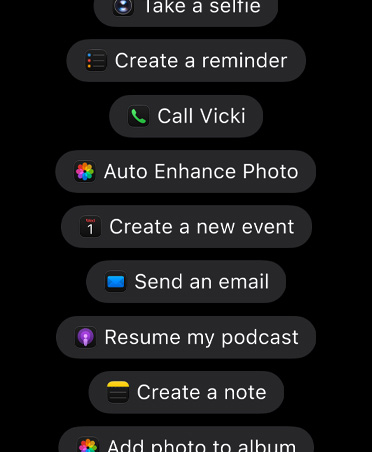
Apple's published footnotes say Siri AI is available in beta across the version 27 operating systems and requires an Apple Intelligence-enabled device set to a supported language. The page also lists language and regional qualifications, including that Siri AI will not initially be available in the EU on iOS, iPadOS and watchOS.
Some server-based Apple Intelligence features are subject to daily usage limits. Apple says those limits may vary with the feature, request complexity and other conditions, and that expanded access will be available for a fee in the future. That is not a published price for the reported agentic Siri, and it should not be represented as one.
The practical lesson is to check Apple's current availability and system requirements for the feature you need. A broad statement that a device supports Apple Intelligence does not guarantee access to every capability, language or future service tier.
More autonomy makes permissions more important
A proactive assistant needs clear boundaries around what it can read and what it can change. Apple's official materials emphasize on-device processing and Private Cloud Compute. Those are descriptions of the company's current privacy approach, not proof that every possible future agent workflow has already been resolved.
Separately, Apple has announced tighter Full Disk Access controls for macOS. That policy addresses the risks of giving applications broad access to files, mail and messages as agents become more autonomous. It provides relevant context for this roadmap discussion, without establishing the exact permission model of a future Siri release.
When evaluating any agent, useful questions include whether an action can be reviewed before it commits, whether access can be limited and how failures are surfaced. Sending a message, spending money and searching a local note do not carry the same consequences. The ability to act should not be mistaken for an obligation to act without confirmation.
What to watch for next
The same 9to5Mac report describes a possible change to Apple's early iOS 28 engineering cycle, with six weeks of coding and exploration followed by two weeks of integration instead of two four-week phases. That internal-process claim is also reporting, not a public guarantee of faster delivery or better software.
The useful next milestones would be official documentation of agent behavior, explicit availability details and demonstrations that distinguish scheduled or multi-step work from a normal conversation. Until then, today's product pages are a firmer basis for decisions than a projected roadmap.
Agentic Siri is worth watching because Apple already connects its assistant to personal context and app actions. Whether those foundations become dependable, proactive help depends on execution and boundaries that this report cannot yet verify. There is no confirmed 2027 launch date or price to report.
Sources: 9to5Mac report, Apple developer announcement, Apple Intelligence features and availability, Apple Privacy & Security guide.
Related: Raycast Dictate to AI Adds Voice and Active-App Context.