Project Meridian FX APAC: What the Settlement Trial Proves
Summary
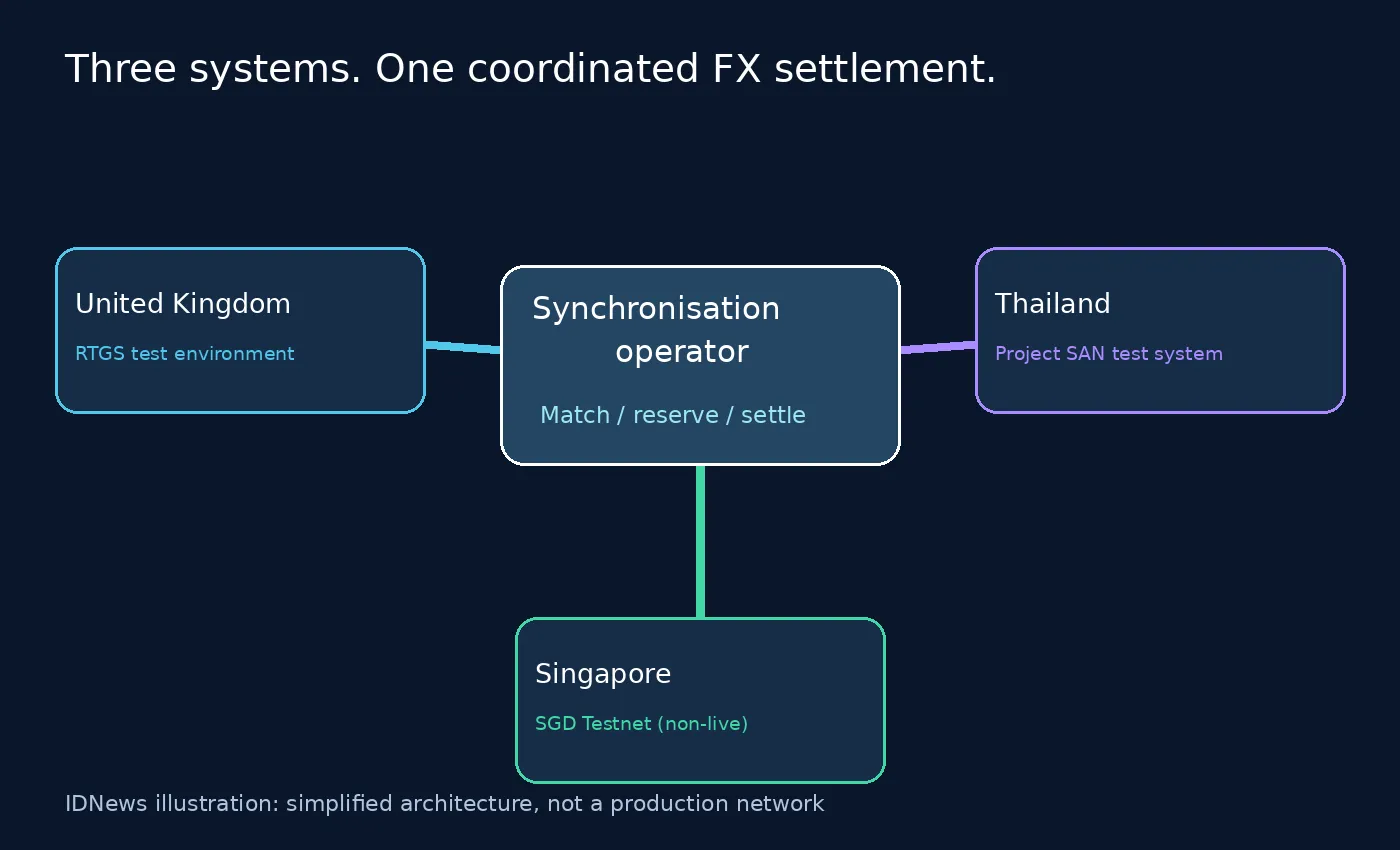
Featured image: Original IDNews explanatory illustration, based on the central banks’ technical report. Simplified, not a production network.
Project Meridian FX APAC has demonstrated coordinated foreign-exchange settlement across three central-bank test environments with different architectures. The result is about making separate payment systems work together, not launching a public cryptocurrency, a retail wallet or a new remittance app.
The Bank of England, Monetary Authority of Singapore and Bank of Thailand published their findings on November 13, 2026. Their joint announcement says the trial tested payment-versus-payment settlement and multilateral net FX settlement, with Partior developing, integrating and testing the synchronisation-operator prototype.
What Project Meridian FX APAC actually tested
The participating environments were the Bank of England’s Synchronisation Lab, Thailand’s Project SAN and a non-production configuration of Singapore’s SGD Testnet. They represent different approaches, from account-based real-time gross settlement to token-based infrastructure. The point was not to migrate all three onto one common ledger.
Instead, a coordination layer matched instructions and arranged for the relevant funds to be reserved before settlement. The simplified featured illustration shows this relationship, not a screenshot of operational banking infrastructure. The official release and technical-report pages were checked for project photography; an original architecture illustration is used because it explains the experiment without presenting unrelated bank buildings as trial evidence.
For Singapore readers, the qualification around SGD Testnet is important. The report says the environment was used in a non-live configuration for this experiment. A reference to wholesale central-bank digital money in the design does not mean households can sign up for a new digital Singapore-dollar service.
Why payment-versus-payment matters
An FX transaction has two currency legs. If one side pays but the other does not deliver, the first participant faces settlement risk. Payment-versus-payment, or PvP, links the transfers so the exchange is not treated as two unrelated payments.
The project’s technical report describes a sequence of instruction, matching, fund reservation and settlement. Because the systems expose different capabilities, the operator uses system-specific adapters and different reservation arrangements. Interoperability still requires integration work; it is not achieved merely by calling each ledger a blockchain.
One useful distinction is between the economic aim and the operational process. Saying transfers happen together does not mean every underlying system responds at the identical instant. The report describes how instructions are coordinated and how the operator responds when a system becomes unavailable.
The failure boundary is more important than the headline
Before commitment, a failed reservation can cause the operator to cancel existing earmarks and terminate the transaction. Insufficient funds or an invalid account can therefore prevent settlement rather than allowing one leg to proceed alone.
After the first settlement instruction has been issued, the report describes an irreversible phase. If another system becomes unavailable, the operator retries until that system returns rather than attempting a rollback that could release one side independently. That is a more precise account than saying all failures simply reverse every payment.
The report also distinguishes technical commitment from legal settlement finality. A working prototype is evidence about a technical design; it does not by itself resolve the legal effect of a transfer across every jurisdiction. Operations, governance and legal arrangements remain part of moving toward real-world use.
Netting changes how much liquidity must be reserved
The second use case groups eligible non-urgent transactions into settlement cycles and calculates participants’ net positions. Instead of funding every gross outgoing payment separately, an institution may only need to provide the resulting net obligation for the agreed batch.
As a simplified arithmetic example, if a participant owes 100 units and is due 80 units in the same currency within an eligible netting set, its net outgoing amount is 20. This is an explanatory example, not a reported transaction or measured saving from the trial. Actual eligibility and settlement obligations depend on the system rules and the batch that all systems accept.
The experiment demonstrated combining this liquidity-saving approach with synchronised settlement. It did not establish a universal percentage reduction in banking costs or guarantee cheaper consumer transfers.
What to watch before calling it a live service
The Bank of England points to a planned live synchronisation interface in 2028. That is a stated plan for its infrastructure, not a confirmed launch date for a production version of this entire three-country arrangement. Further work may involve additional jurisdictions, currencies, participants and legal arrangements.
Useful next milestones are named live participants, production operating rules, oversight arrangements and a clearly defined launch scope. The distinction also matters when reading about DTCC’s separate tokenization plans: tokenized infrastructure, asset rights and public access are different questions. Meridian’s contribution is evidence that coordination can bridge diverse wholesale systems, with its limitations visible rather than hidden behind a launch headline.