Chainalysis Chain AI: Preview Access and Evidence Limits
Summary
Chainalysis Chain AI is an investigative workspace designed to turn plain-language questions into crypto-analysis workflows. As of November 27, 2026, it is in limited preview, not a general release for every customer. Chainalysis says broader customer access is planned for January 2027. For compliance teams, the central question is not only how quickly it generates an answer, but how that answer can be checked.
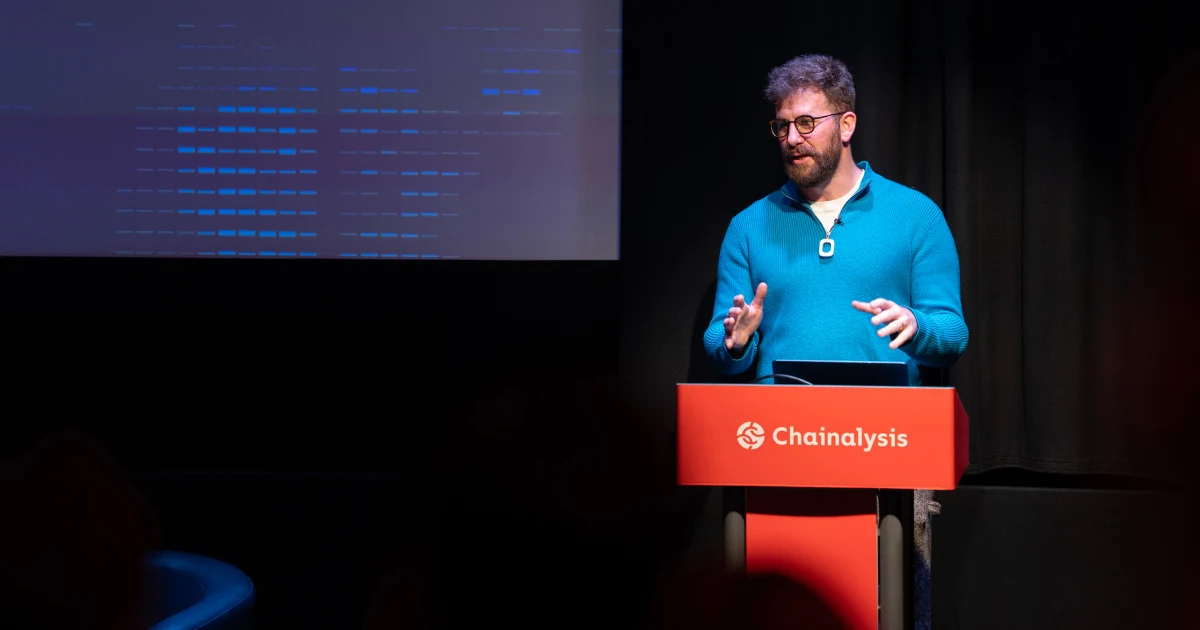
Featured image: Chainalysis. Official Nodes London event photograph.
What Chainalysis Chain AI is intended to do
In its Nodes London announcement, Chainalysis describes Chain as an AI-native workspace for following money flows. It accepts plain-language questions and draws on the company’s accumulated intelligence. The announcement says it works inside supported workflows, including Reactor and KYT, and connects to other AI tools through Model Context Protocol, or MCP.
That is a description of supported integrations, not a promise that any external system can be attached without configuration or controls. The company’s example is an investigator asking about an address and having agents carry out parts of the analysis. The result should be understood as investigative assistance: agents gather and process information while humans judge the output.
Chainalysis says Chain had already been central to internal work for nearly a year. It cites use in tracing a major theft across bridges and decentralized-finance protocols. Those are company statements about its own investigations, not an independent benchmark establishing how the product performs on every case.
Limited preview is different from broad availability

The announcement says selected customers already have preview access and that teams can register for early access or request a demo. Broader availability is planned for January 2027. A team considering a purchase should verify eligibility and contractual terms directly rather than assume the product is included in its existing subscription.
No universal price, unrestricted public signup or complete deployment specification is established by the announcement. Those omissions matter for budgeting: a successful product demonstration is not evidence that a particular organization can use the same integrations with its own data, permissions and operating constraints.
A useful first conversation with the vendor should establish which workflows are enabled in the preview, what data the agents can read, and what a reviewer can inspect afterward. These are evaluation questions, not claims that Chain lacks those controls. The public announcement simply does not answer them in sufficient detail for a production acceptance decision.
How to read the MoonPay speed claims
Chainalysis presents MoonPay as an early user, quoting its risk director Brian Higdon about reducing repetitive investigative work. One passage describes agents completing in five minutes a task that previously took 45 minutes. The same page’s FAQ more broadly says investigative work time was cut in half.
Those statements need not refer to the same task, but neither supplies a standardized benchmark methodology. It would be misleading to turn the five-minute example into a universal productivity promise, or to blend both figures into an average. They are attributed customer claims in a vendor announcement.
A prospective buyer can use them to design an evaluation instead. Choose one repeatable investigation type, define a correct result in advance, measure analyst review time as well as agent execution time, and record cases where the workflow cannot reach a defensible conclusion. That is a proposed evaluation method, not a test conducted for this article.
The missing step between a lead and a finding
Consider a hypothetical review of funds passing through several services. An AI-generated path can help an analyst decide where to look next, but a path is not automatically proof of illicit ownership or intent. The reviewer still needs to know which transactions support each connection and where labels or attribution introduce uncertainty.
For that example, a defensible output would distinguish observed on-chain transfers from service labels, inferred relationships and unresolved gaps. It would also make the source and time of a label clear enough for review. These are evidence requirements for investigation, not a claim that the product interface has been independently inspected.
Teams should separately assess the consequence of a wrong answer. A lead sent for further research has a different risk profile from a decision that restricts a customer account. The announcement’s emphasis on humans judging output is important because automation speed alone does not establish a valid basis for an adverse decision.
What to ask before connecting an AI workflow
MCP connectivity widens the integration conversation, but does not remove ordinary access-control responsibilities. Ask which tools the agent may invoke, whether those tools only read information or can change a case, and how permissions are scoped. Confirm what is logged and how an analyst can revisit the evidence behind an output.
The broader software-agent trend also appears in our report on local AI agent evaluation and benchmark limits. The products serve different jobs; the shared lesson is to test the specific workflow rather than transfer a headline benchmark into an operational guarantee. That link is context, not a claim that Bonsai integrates with Chain.
Chain’s practical promise is reducing repetitive work inside a specialist investigative environment. Its current limitation for outside assessment is that the public evidence consists largely of vendor descriptions and selected customer experience. Until a team can evaluate its own cases, treat January 2027 as a planned availability milestone and the performance claims as hypotheses to validate, not procurement facts already proved.