ChatGPT Enterprise on AWS Marketplace: Buying Is Not the Same as Hosting
Summary
ChatGPT Enterprise is available through AWS Marketplace, giving organizations another purchasing and billing route. The critical distinction is that buying through AWS does not guarantee that all customer data stays on AWS infrastructure or inside the buyer’s own AWS environment. Procurement and data-governance decisions still need separate checks.
Primary reference: OpenAI’s Marketplace announcement. Availability and documentation checked November 10, 2026.
What the Marketplace announcement actually changes
As of November 10, 2026, OpenAI’s announcement says organizations can discover, buy and manage ChatGPT Enterprise through their existing AWS purchasing relationship. Eligible spending can count toward AWS commitments. Both the announcement and the official Marketplace listing make eligibility a matter to confirm, not a universal entitlement attached to every AWS account.
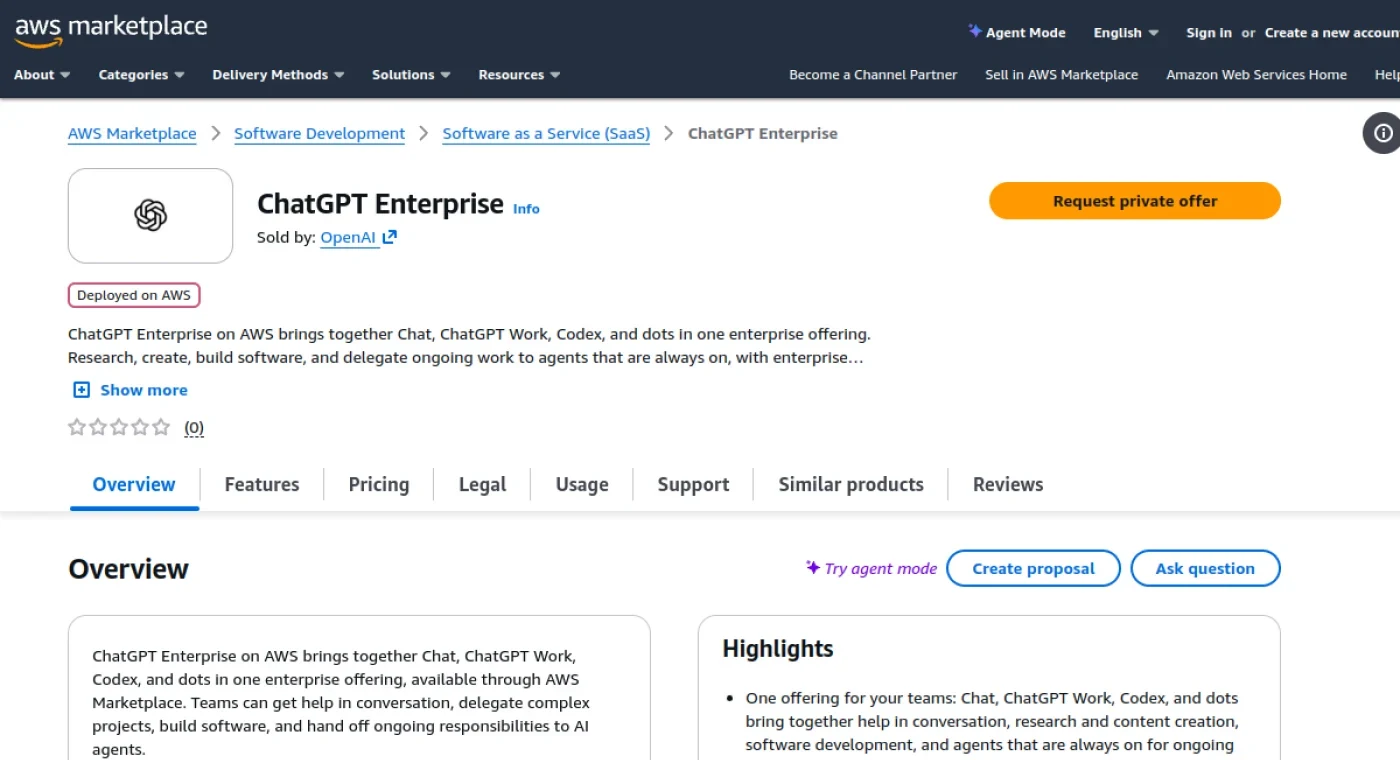
This can matter to a company that already has a cloud procurement process but has not yet approved a separate purchasing arrangement for ChatGPT Enterprise. It does not remove the need for a commercial review. The listing presents a private-offer request route, so buyers should establish the actual offer, billing arrangement and applicable terms rather than assume a public self-service price.
The product offering, and the limits of parity
OpenAI says Marketplace customers receive the same models, features and functionality offered directly, with new features released at the same time. The offering brings together Chat, ChatGPT Work, Codex and dots. The listing describes conversation, multi-step research and project work, software development, and ongoing agent responsibilities respectively.
That is a vendor description of the offering, not evidence that a particular organization has enabled every capability. Workspace permissions, connected tools and contractual access still need to be reviewed. Product parity should not be converted into a claim of identical pricing, automatic access to every region or exemption from enterprise governance.
OpenAI also says eligible customers can access ChatGPT for Healthcare and ChatGPT for Financial Services through Marketplace. Buyers in those sectors should confirm eligibility directly with their OpenAI or AWS account team. The announcement is not a substitute for a regulated organization’s own assessment of its intended data and workflows.
Why an AWS purchase is not a data-residency guarantee
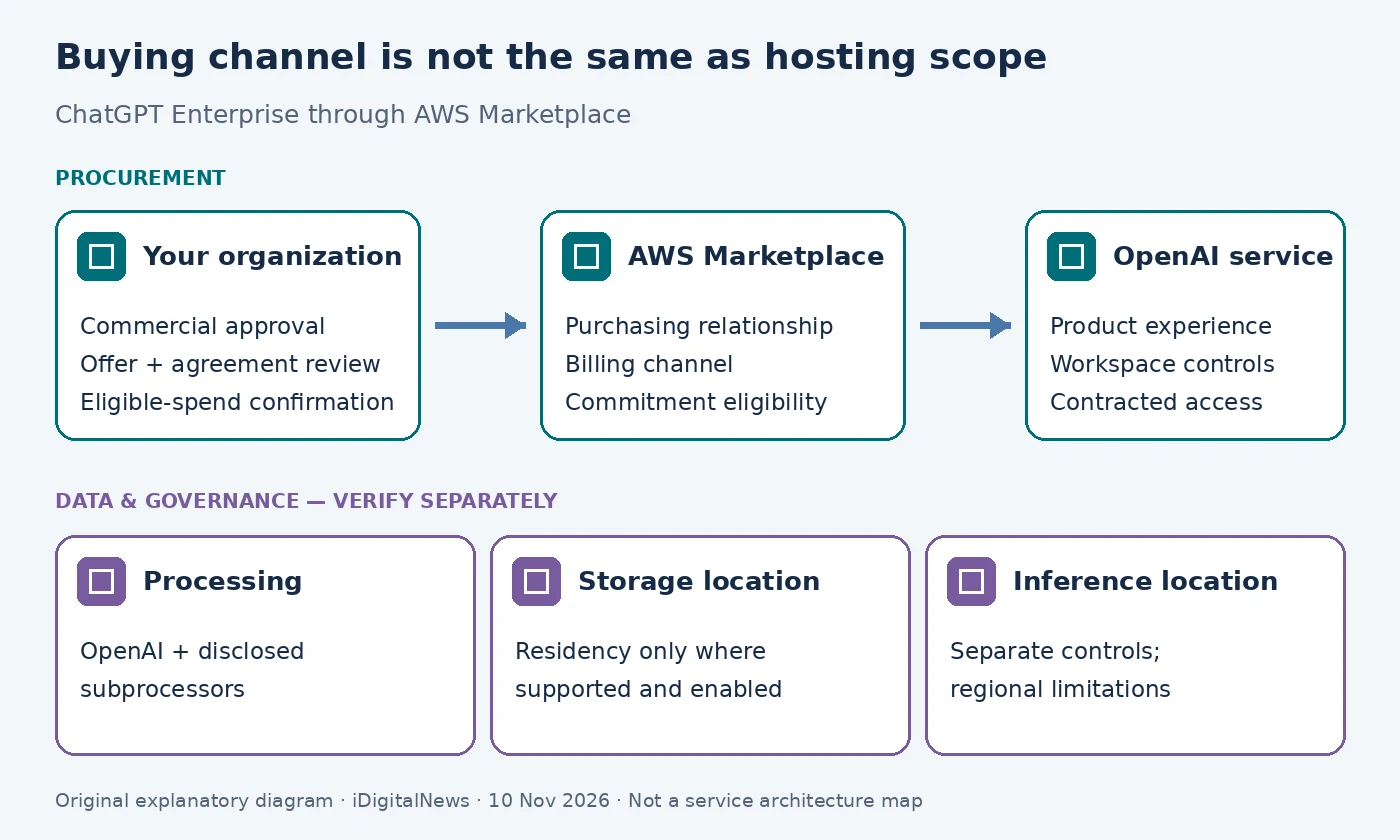
Original iDigitalNews diagram based on the official listing. Purchasing, storage residency and inference residency are separate questions; this is not a service architecture map. Image context/source.
The most consequential clarification appears in the Marketplace description: OpenAI remains the data processor and uses disclosed subprocessors, including AWS. Purchasing through Marketplace does not guarantee that all customer data remains on AWS infrastructure or in the customer’s AWS environment.
The listing distinguishes data residency, which concerns where supported customer content is stored at rest, from inference residency, which concerns where model inference on that content runs. Options apply only where supported and enabled, are not available in every region, and do not cover all processing or systems data.
A procurement team should therefore ask two different questions: “Can this purchase use our AWS commercial arrangements?” and “Does the service configuration meet our processing and location requirements?” A positive answer to the first does not settle the second. The diagram separates these questions; it is an explanatory view, not a map of service infrastructure.
Marketplace procurement versus Amazon Bedrock
OpenAI positions the Enterprise listing as complementary to OpenAI models available through Amazon Bedrock. A company can buy an employee-facing product and separately build applications or agents using model access. The two decisions should not be collapsed into one licensing or deployment assumption.
The distinction is visible in official OpenAI documentation for local ChatGPT Work and Codex with Bedrock. That separate configuration sends model requests to Bedrock using AWS-managed authentication and access controls. It has its own requirements and feature limitations. Buying ChatGPT Enterprise through Marketplace does not by itself configure that model-provider route.
| Question | What to verify |
|---|---|
| Buying an employee-facing Enterprise offering? | Marketplace offer, workspace access and commercial eligibility. |
| Building with models through Bedrock? | Model access, region, permissions and application requirements. |
| Keeping particular data in a location? | Enabled residency options, covered data and contractual limitations. |
A practical checklist before requesting an offer
Finance should confirm which charges, if any, count toward its AWS Enterprise Discount Program or Private Pricing Agreement commitment under the actual agreement. An account team’s written explanation is more useful than an assumption based on the existence of a Marketplace listing.
IT should establish the intended users, access controls and connected tools. Security and privacy teams should review the processing terms, subprocessor disclosures and supported residency configuration. The listing says business data is encrypted in transit and at rest and is not used to train OpenAI models by default; that statement does not answer every retention, access or regulatory question.
Finally, distinguish a proposed business workflow from a verified capability in your own environment. For example, planning a document-research pilot does not prove that a particular connector is approved or available. Define a bounded task and success criteria before broad rollout, rather than treating purchasing approval as completed deployment.
What buyers should take away
The announcement offers another commercial channel, not a shortcut around service evaluation. It is useful when an existing AWS relationship simplifies purchasing and eligible spending aligns with the agreement. Direct purchasing may still be relevant; compare the actual offers and governance requirements rather than assume either route is automatically cheaper.
For the broader distinction between enterprise agents and their operating controls, see our OpenClaw enterprise-agent coverage. This Marketplace guide is documentation-based; no private offer was requested, account connected or enterprise product benchmark performed.
Featured image:
Public AWS Marketplace listing captured on November 10, 2026, via Thum.io. Cropped to the listing overview. Interface and marks: AWS/OpenAI; no private account is shown. Image context/source.