Gemini 4 Hydrogen: API Costs, Free Access and Agent Limits
Summary
Gemini 4 Hydrogen, announced by Google on November 12, 2026, is aimed at everyday coding and agentic execution rather than replacing every higher-end reasoning model. The practical questions are where you can use it, what API workloads cost and whether a faster model actually improves your own workflow. Google’s launch figures are useful starting points, but they are vendor claims, not independent results from our testing.
Featured image: Official Gemini Hydrogen product demonstration; not our hands-on test. Credit: Google.
Gemini 4 Hydrogen access depends on the product
Official Gemini Hydrogen product demonstration; not our hands-on test. Credit: Google. Context and source.
Google says Hydrogen is rolling out across AI Studio, the Gemini API, Gemini for business, the Gemini app and Google Search. Antigravity access is offered to paid Google AI Pro and Ultra subscribers. These are different access routes, not one universal entitlement attached to every Google account. See the primary announcement for the documented details.
In particular, free access through the Gemini app does not mean a free API allowance without limits. Google says free app users receive Hydrogen through automatic model selection when it is appropriate for their prompt. A user therefore should not assume that every conversation is running Hydrogen or that the same manual picker controls apply to every subscription.
For a team evaluating adoption, start by writing down the surface you actually use: app, API, business deployment or coding environment. Then check the account’s offered models and plan conditions. A rollout announcement is not proof that a specific enterprise administrator has enabled the model or that every product feature is available in every account.
API pricing: calculate the whole workflow
Google lists pricing of $1.50 per million input tokens and $7.50 per million output tokens, flat across the advertised one-million-token context window. Output is therefore five times as expensive per token as input at those listed rates. The size of the supported context window is a capacity limit, not a recommendation to fill it on every request.
A simple hypothetical calculation illustrates the difference. A workload using 100,000 input tokens and 10,000 output tokens would have a base token charge of $0.15 plus $0.075, or $0.225, using the announced rates. This is an arithmetic example, not a measured bill. Tool charges, additional model calls and any other applicable service costs are outside that calculation.
Agent tasks often make several calls. A model that finishes an individual answer quickly can still cost more overall if it needs repeated repairs or long outputs. Compare total accepted-task cost and elapsed time, not just the cheapest-looking single response. Do not equate a consumer subscription price with usage-based API billing.
Thinking levels and Orchestrator solve different problems
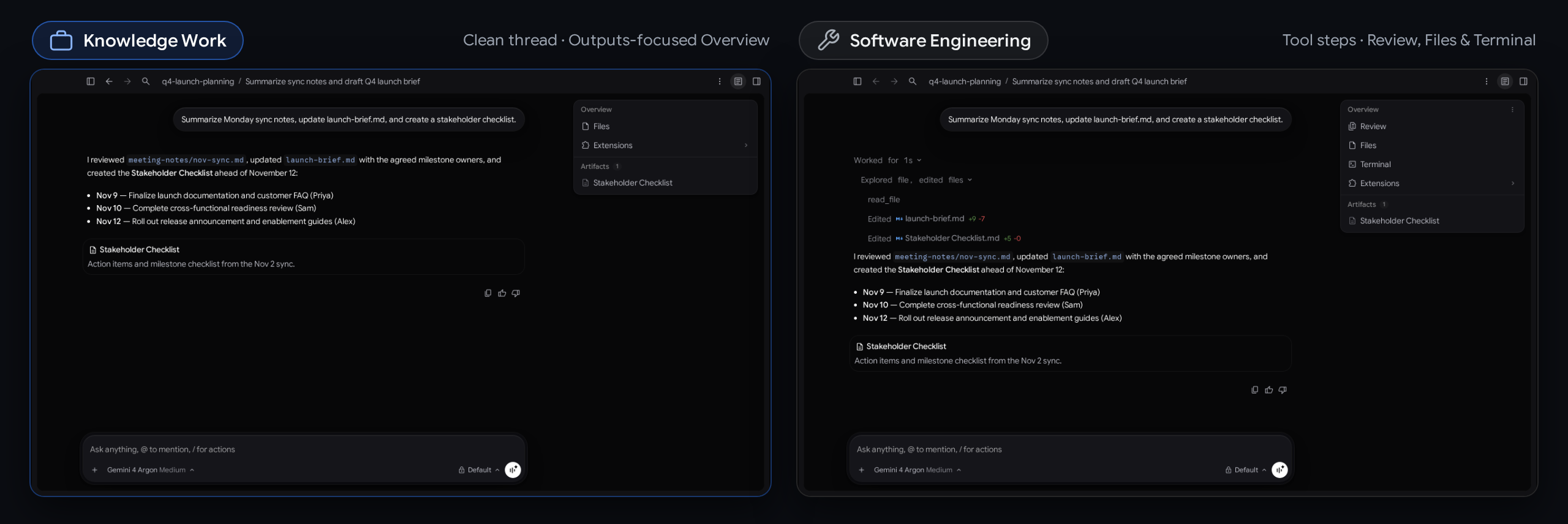
Hydrogen offers low, medium, high and xhigh thinking levels, with high as the default according to Google. These options allow an application to trade reasoning effort against response latency and consumption. Google also introduced Antigravity Orchestrator, which switches models within a session rather than treating one model as the answer to every step. For a separate but related development, see our coverage of the Antigravity Knowledge Work layout.
In Google’s proposed division of labor, Carbon can coordinate difficult work while Hydrogen handles execution and verification tasks. Google reports that Orchestrator used 24% less quota and completed 19% faster on average while approaching Carbon task-success rates on Terminal-Bench 4.0. Those figures describe the vendor’s evaluation, not a guaranteed reduction for your repository.
A sensible pilot would keep one bounded task, the same repository revision, the same permissions and the same acceptance checks. Record whether the final change works, how many interventions were needed and the total resources consumed. This is a proposed evaluation method; we have not run that experiment for this article.
Fewer reported errors do not remove review
Google reports gains over Gemini 3.8 Flash in speed, fabricated-claim rates and agent behavior. Such comparisons depend on evaluation setup and baseline. They do not establish that every output is correct or that an agent should receive broader permissions simply because the model is newer.
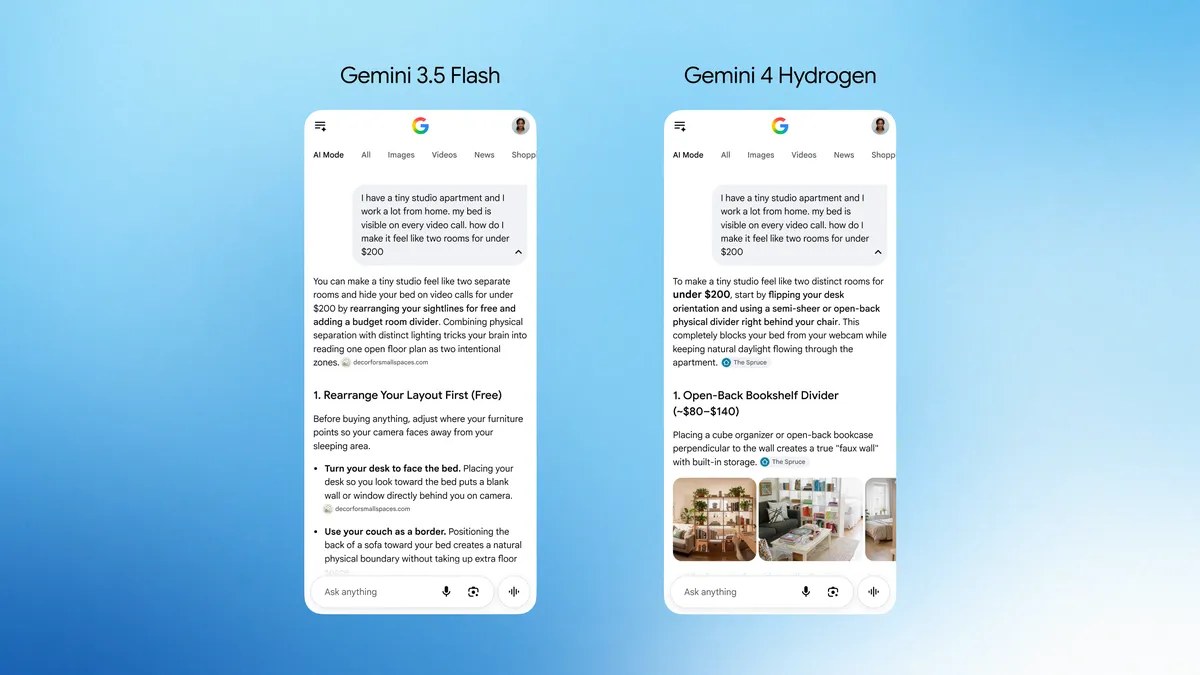
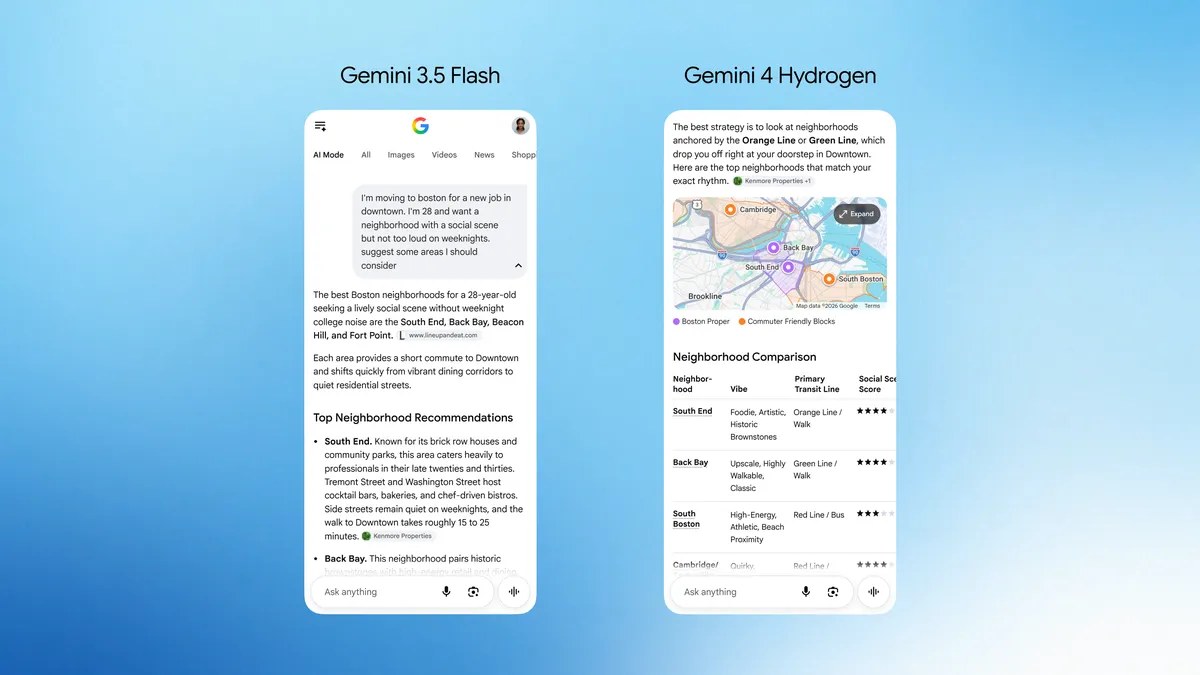
The official Search demonstrations show richer layouts and links, including visual comparisons. They illustrate Google’s intended experience rather than proving the completeness or accuracy of any particular answer. Follow important links and verify consequential facts against the underlying source.
For developers, the immediate decision is whether Hydrogen meets a specific execution need at a useful total cost. For app users, the key distinction is between automatic access and guaranteed manual selection. In either case, treat benchmarks as a reason to evaluate, not a replacement for checking the final work.