Gemini History and AI Training Split: What Still Gets Saved
Summary
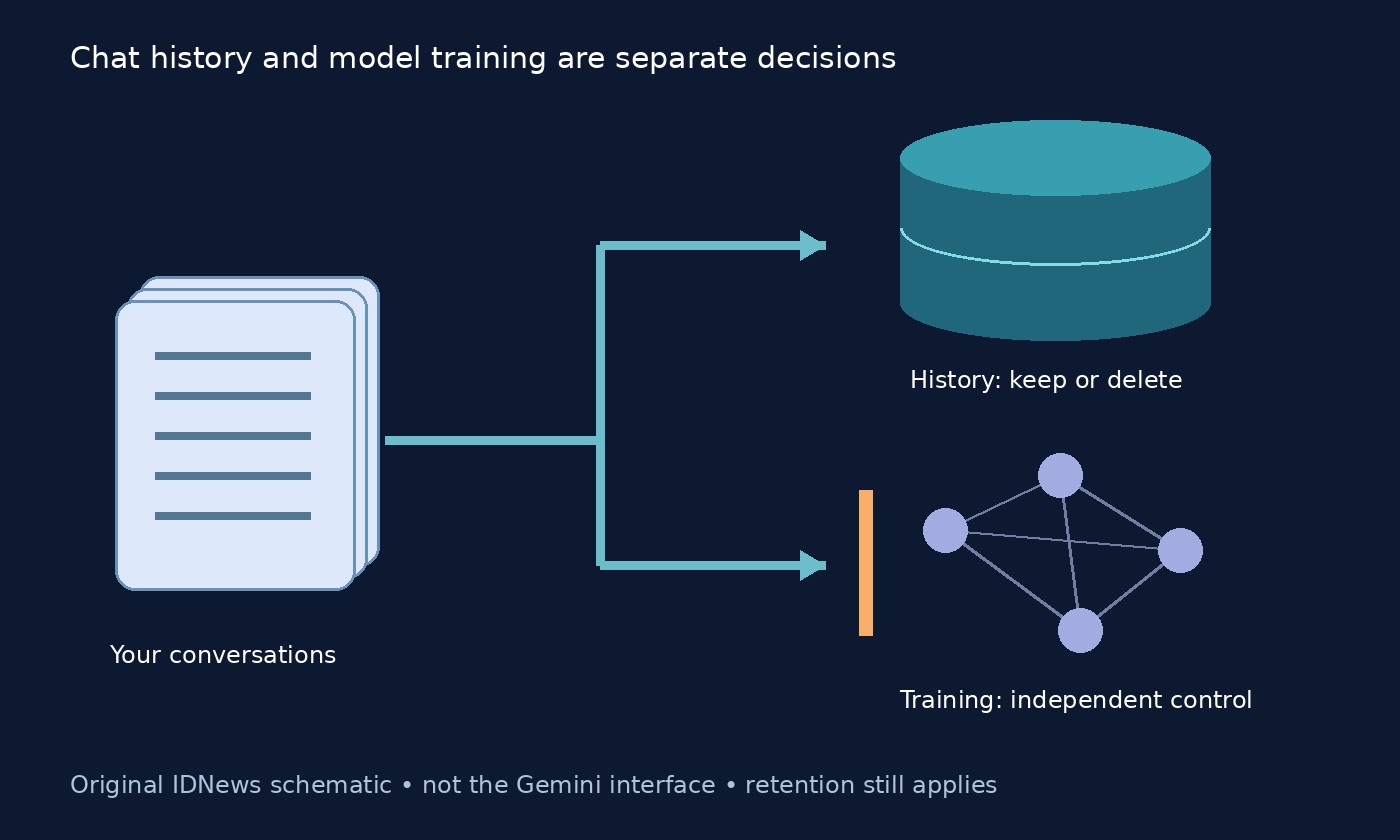
Featured image: Original IDNews schematic, not a Gemini interface screenshot.
Gemini history and AI training are becoming separate choices. Google says you will be able to keep past conversations available while independently opting out of using chat content to train generative AI models. The less obvious change is retention: switching History off will not mean your next conversation disappears immediately.
Google’s November 16, 2026 announcement says future chats with History off will be saved for around two months. The update is due to roll out globally over the coming weeks, so the presence of the announcement does not prove your account already has the new switches.
What the Gemini history and AI training split changes
In its official announcement, Google describes a new ability to keep history while opting out of generative AI model training. Previously, the Keep Activity setting combined questions about saving chats and training use. Separating them gives users a choice that should not require giving up a useful conversation archive.
That is a narrower promise than “Google stops processing your chats.” Google still needs information to respond, process feedback and protect users and its services. The announcement explicitly links the roughly two-month retention period to those functions when History is disabled.
9to5Google’s reporting says the new History control governs how long history is saved, while a separate control governs training use of text and attachments. It also reports that accounts with Keep Activity off will have both new settings off. Check your actual account after rollout rather than assuming a default migration has occurred.
History off is not zero retention
The updated Gemini Apps Privacy Hub, dated November 16, explains that even with History off, future chats are retained for around two months and used for responses, feedback handling and protection, including with help from human reviewers.
That makes two separate questions essential: can you revisit a conversation through saved history, and how long does Google retain data for other purposes? A user-facing history switch does not, on its own, answer the second question. Do not treat an empty recent-chat list as evidence that no server-side copy exists.
The hub also says chats reviewed by human reviewers and associated data are not deleted when you delete history; those records can be retained for up to three years. It describes other retention exceptions, including security and legal needs. These qualifications matter more than a simplified “training off” label when deciding whether to submit sensitive material.
Choose settings by the task, not just the switch name
Consider a hypothetical student using Gemini to plan a public-domain reading list. They might want the conversation available next month without contributing its content to model training. Once the new controls arrive, that is the combination the split is designed to support. This example illustrates the policy choice; it is not a claim that IDNews tested the new interface.
Now consider an employee preparing an unpublished customer report. Turning training off does not establish permission to upload that report. Employer rules, contractual restrictions, connected-service access and human-review provisions remain separate issues. The sensible decision may be to remove identifying details or use an approved work tool rather than rely on a consumer privacy switch.
Our explanation of Gemini’s Google Wallet integration covers the related distinction between permission to act and permission to access data. In both cases, a limited capability should not be mistaken for an absence of data processing.
Review history, connected apps and deletion independently
Google says you can change the history auto-delete period and manually review or delete chats. The Privacy Hub lists an 18-month default, with alternatives including three months, 36 months or indefinite retention. Read the option presented in your account before selecting it; the retention of visible history is not the same as every backend retention exception.
Connected services have their own policies. Google specifically notes that deleting Gemini history does not delete information saved by other Google services used with Gemini, such as Wallet or YouTube. Removing a chat is therefore not a universal delete command for data exchanged across apps.
What to check when the rollout reaches your account
Open your Gemini settings and read the controls actually available. Identify the History setting, the independent training preference and the stated retention explanation. If the account still shows Keep Activity, do not assume a different-looking setting has already inherited all the new behavior.
Keep a simple record of your choices if you depend on a particular configuration, and revisit connected-app permissions separately. The practical benefit of this change is a more precise choice: keeping a useful archive need not mean allowing model training on chat content. Its limit is just as important: opting out of training or turning History off does not make a Gemini conversation ephemeral or inaccessible to every form of review.