GPT-6 Protein Design: What 35 Lab Hits Actually Show
Summary
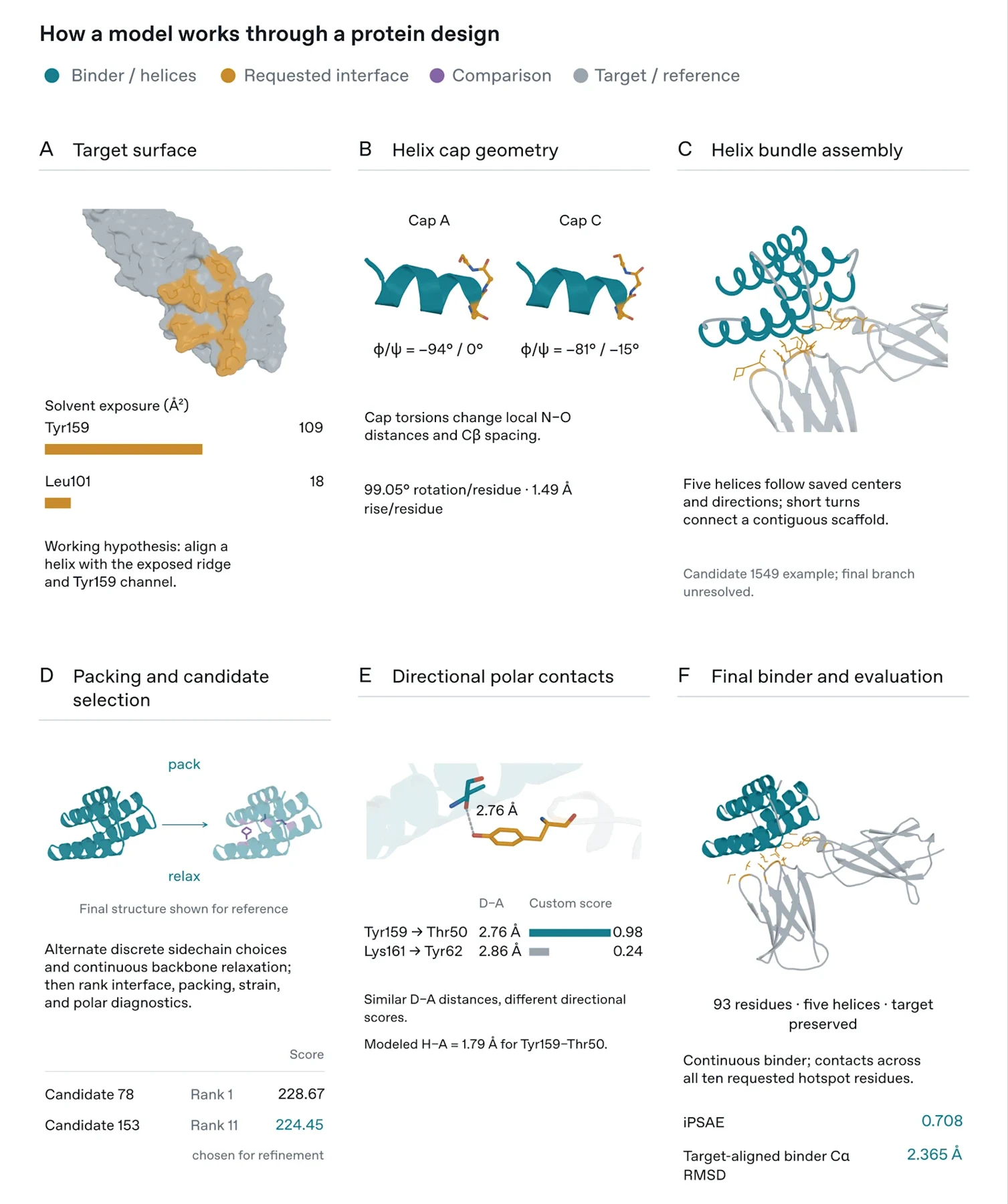
Research figure: OpenAI. Computational designs are not approved medicines.
GPT-6 protein design research has produced proteins that showed evidence of binding in laboratory tests, OpenAI reports. The headline result is 35 positive candidates among 322 tested minibinders across five targets. That is evidence worth examining, but it is not evidence of an approved treatment—or of a complete design-to-lab workflow without specialized biology models.
The important distinction is between the model generating a proposed three-dimensional shape and the broader pipeline that turns it into a testable protein. OpenAI’s own account describes specialized models supplying amino acid sequences and helping choose candidates for laboratory testing.
GPT-6 protein design: what “intrinsic” protein design means here
In OpenAI’s research announcement, intrinsic capability means that GPT-6-family models can propose structures and sequences using reasoning and general-purpose code rather than calling specialized biology models to generate those particular designs. It does not mean every experiment in the study dispenses with specialized tools.
A protein’s sequence is its ordered chain of amino acids. Its structure is the three-dimensional shape that chain takes. These are connected but different design problems. A shape that looks promising computationally still needs a sequence that can realize it, and a laboratory test must establish what the resulting molecule actually does.
OpenAI reports that an internal research model matched or exceeded specialized models on many computational tasks, while complete protein-structure prediction remained a clear weakness. Results from that internal model should not be silently attributed to every publicly available GPT-6 version. The laboratory shape-generation work described in the announcement used a pre-release GPT-6.2 model.
How 322 candidates became 35 binding hits
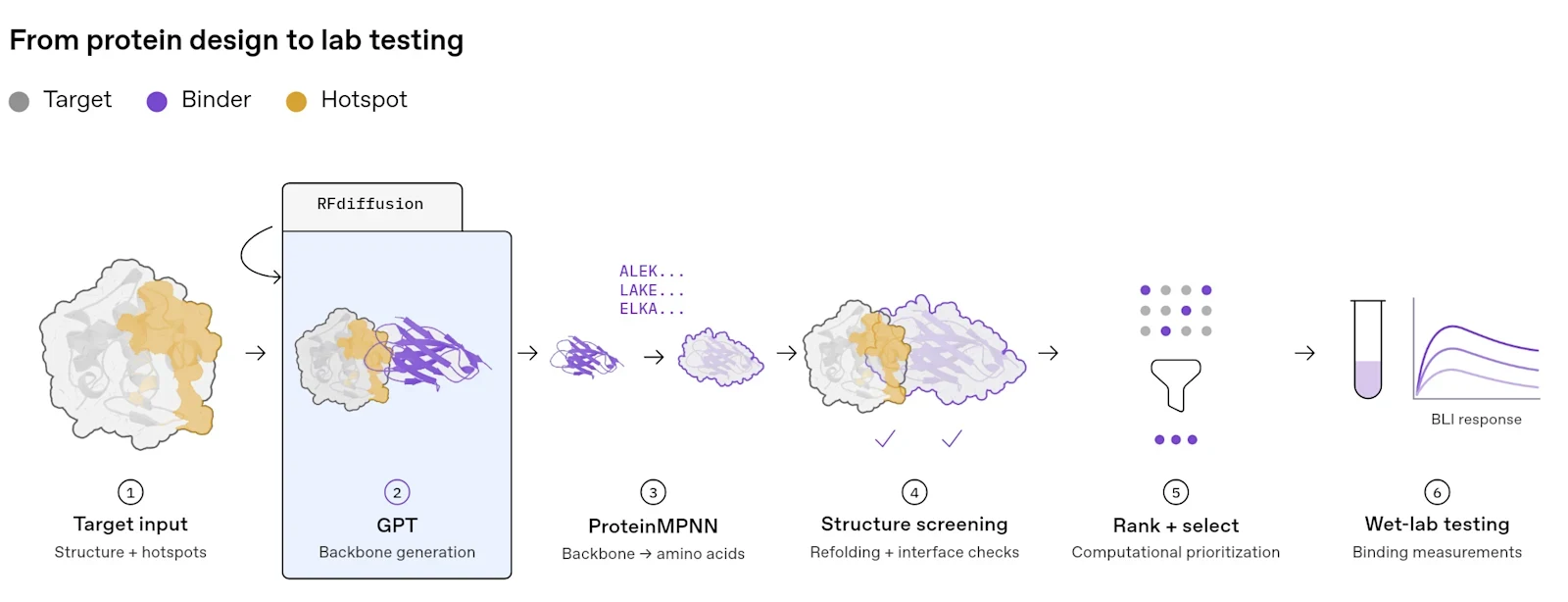
For the first laboratory experiment, GPT-6.2 received structures of five target proteins and marked attachment sites. It generated potential minibinder shapes with code. SolubleMPNN then suggested sequences, and other specialized models helped select candidates likely to fold and bind as intended. Research partner Onava made and tested the proteins.
OpenAI reports 35 hits from 322 tested minibinders, or 10.9%. The counts were five for PD-L1, three for IL-7Rα, one for TrkA, eight for VEGF-A and 18 for IL-17A. At least one candidate showed binding for every target, but the distribution is uneven. A pooled success percentage does not tell a researcher the expected success rate for a new target.
The company notes that the original RFdiffusion study reported higher hit rates, while cautioning that filtering and definitions of binding differ. That caveat prevents a clean ranking from the headline percentages alone. A fair comparison would need aligned targets, candidate-selection budgets, assay conditions and success thresholds. We have not independently reproduced these experiments.
Sequence redesign is a different test
Another experiment withheld the original sequences of existing minibinders and asked GPT-6.2 to propose new ones for their structures. Specialized models again assisted candidate selection. Initial screens reported binding in 75 of 88 designs for MDM2, 26 of 42 for VEGF-A and eight of 59 for PD-1.
Those results answer a narrower question than designing a binder from scratch. Starting with a structure already associated with binding provides a different kind of information. The rates therefore should not be added to the first experiment or marketed as a single universal success rate.
OpenAI also reports binding from redesigned antibody fragments. Retaining binding after sequence changes is a useful early signal, but it does not establish improved selectivity, safety or therapeutic effectiveness. Binding is one measurement in a much larger development process. Our earlier explanation of MedChemBench’s drug-discovery limits addresses the related mistake of treating an AI evaluation score as clinical evidence.
How to read the computational benchmark claims
The announcement describes motif scaffolding: building a protein around a specified arrangement of amino acids. It reports a preliminary 43.7% computational success rate for its latest internal model, compared with 27.8% for RFdiffusion in that evaluation. These are computer checks, not laboratory demonstrations of the intended biochemical function.
The separate MotifBench paper explains why evaluation definitions matter. Its pipeline uses sequence generation and structure prediction to assess whether a proposed scaffold preserves a motif and matches the designed structure. It also distinguishes success rate, novelty and the number of unique solutions. Passing a geometric check is not the same as proving an enzyme performs a desired reaction.
For readers evaluating the news, keep three columns separate: which model generated the design, which specialized tools selected or completed candidates, and which result was actually measured in the lab. As of November 26, OpenAI’s findings support further investigation into general-purpose models as research tools. They do not support skipping expert screening, experimental validation or the subsequent work needed to establish a useful and safe medicine.