OpenAI Distillation Defenses: What the 0.2% Test Means

Summary
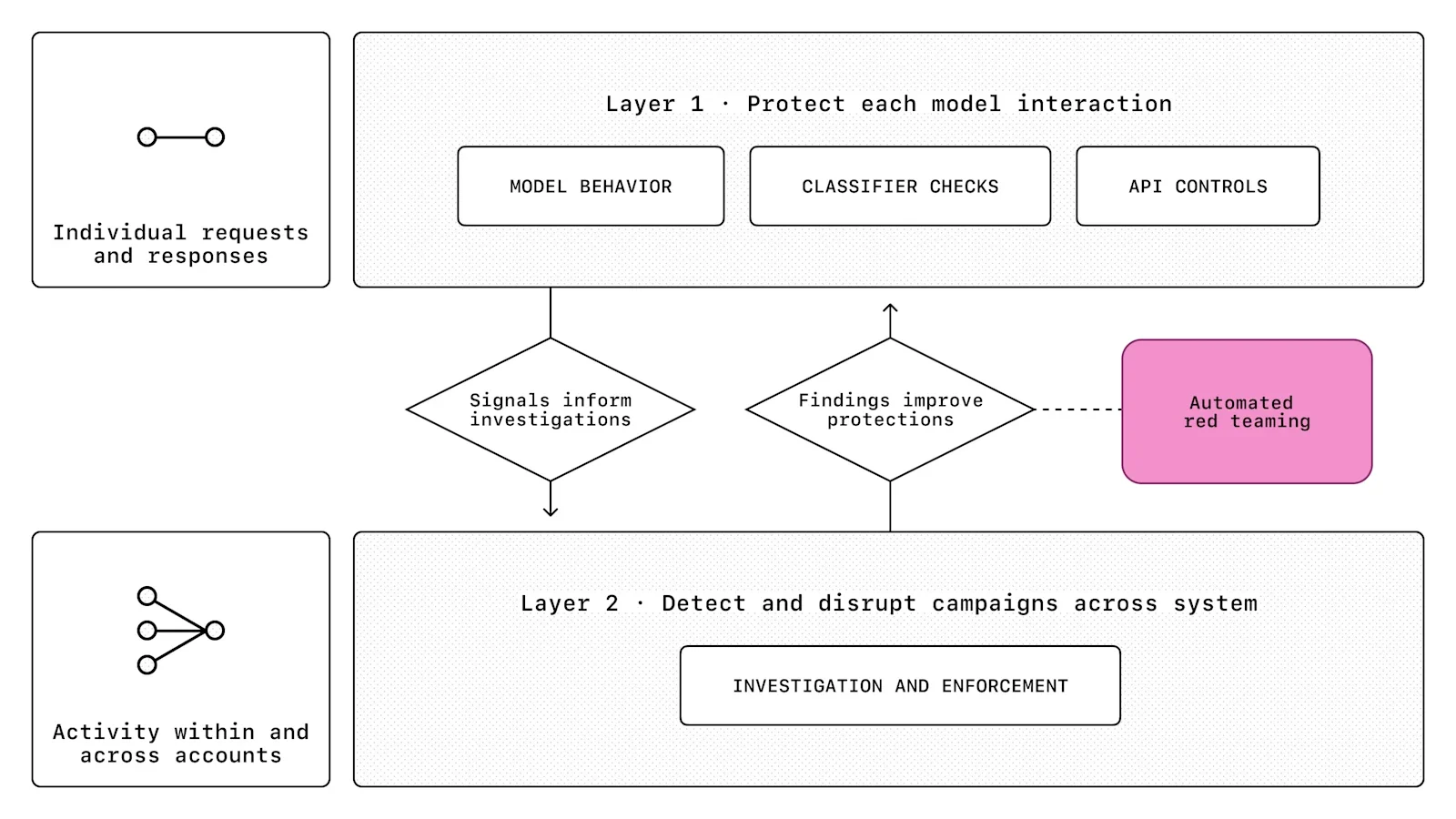
OpenAI distillation defenses combine model training, classifiers, API protections and investigations into coordinated extraction campaigns. In a new technical disclosure, the company reports that an internal adaptive test recovered protected reasoning from an earlier request in 0.2% of attempts against GPT-6.2 Astra, compared with 54.0% against GPT-6 Astra with its original safeguards. Those are vendor evaluation results, not a universal probability of compromise.
Featured diagram: OpenAI; official product source. Official substantive illustration, not a product screenshot.
What OpenAI distillation defenses are protecting
In its primary disclosure, OpenAI distinguishes ordinary model distillation from unauthorized attempts to transfer capabilities without comparable safeguards. Distillation is a training technique in which a student learns from a teacher’s outputs. The specific concern here is extraction of protected reasoning: internal intermediate traces, rather than just the final answer or a user-facing explanation. A student trained on such traces may learn capabilities beyond the benign task that originally produced them. This is OpenAI’s stated safety rationale; the disclosure does not establish that every use of synthetic training data is malicious or that all forms of model learning pose identical risks.
Read the two extraction tests separately

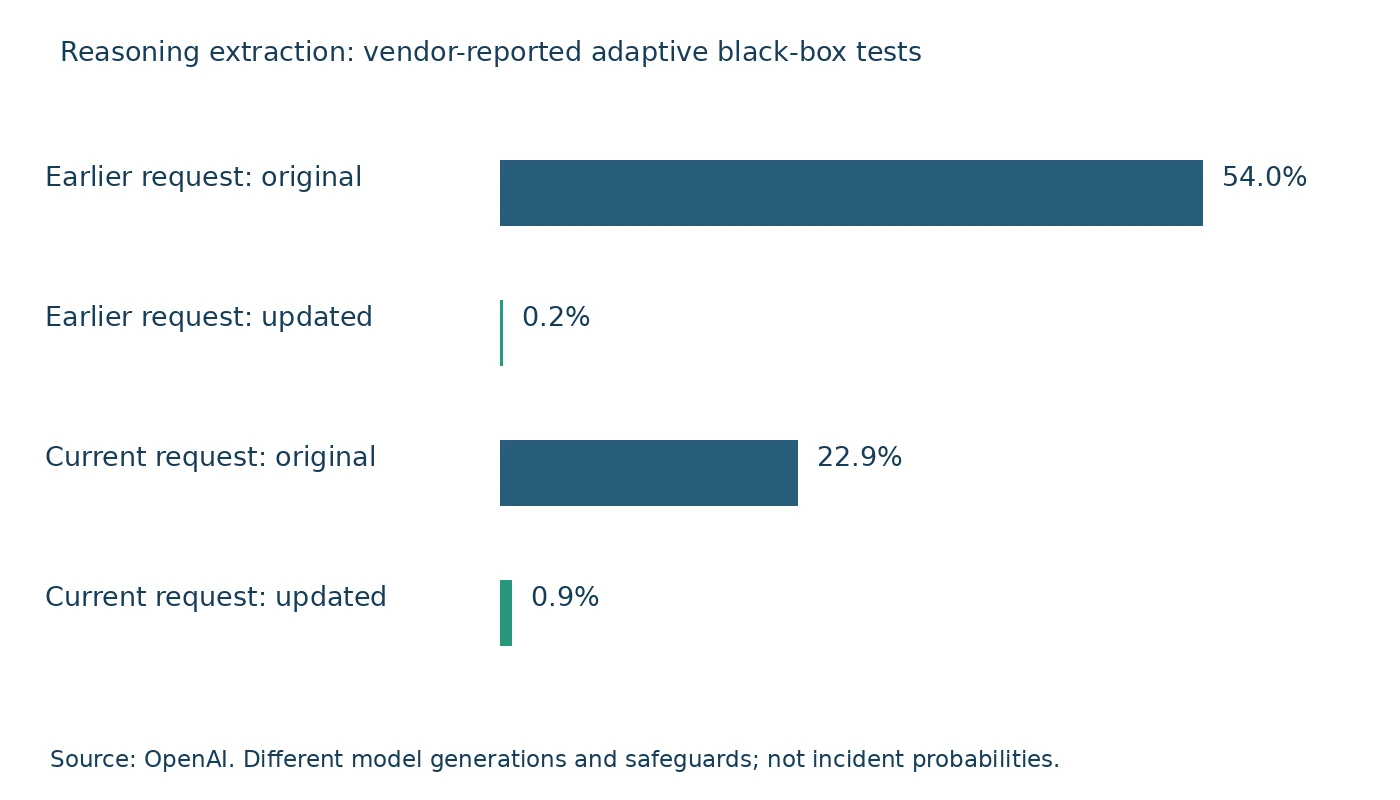
The disclosure reports two adaptive black-box attack categories, aggregated across six attacker models. Recovering protected reasoning from an earlier request had a reported attack success rate of 54.0% for GPT-6 Astra with original safeguards and 0.2% for GPT-6.2 Astra with updated safeguards. Extraction from the current request was 22.9% and 0.9%, respectively. Keep those rows separate: they describe different attack situations. The comparison also changes both the model generation and the safeguard package, so it does not isolate one classifier or one training intervention. Our chart reproduces the published percentages; it is not a reproduction of the underlying experiment.
Why 0.2% is not a deployment risk forecast
A benchmark rate depends on the attacks, sampling procedure, system configuration and success definition used in the evaluation. It cannot be read directly as the chance that a particular organization will suffer an incident. Nor does a reasoning-extraction result measure every other security property of an AI application. An application can still have separate authorization, data-handling or tool-permission problems that this test does not assess. For buyers, the useful question is not simply which number is smaller, but whether a measured failure mode resembles the workflow they plan to deploy. No independent red-team reproduction or production incident-rate study was performed for this article.
The defense includes tool arguments and conversation history
OpenAI says output classifiers inspect both assistant messages and tool-call arguments because a leak could appear in either place. It also describes tying protected reasoning to the conversation history that produced it: rewriting an earlier message causes subsequent reasoning to be dropped. Older model families with weaker safeguards are prevented from reading GPT-6.2 Astra and Sol protected reasoning, according to the disclosure. These are descriptions of the company’s controls, not instructions for extracting traces or guarantees that every integration exposes the same behavior. The related GPT-6.2 Astra and Sol cost guide addresses workflow economics; lower extraction success and lower operating cost are different selection criteria.
A practical checklist for evaluating the claim
First, record the exact model and safeguard configuration behind each number rather than treating all Astra deployments as interchangeable. Second, distinguish static replay tests from adaptive attackers that alter their strategy in response to defenses. Third, ask whether tool calls, streamed responses and cross-conversation boundaries are covered in the system being assessed. Fourth, keep campaign detection separate from per-request refusal: investigating account networks addresses a different scale of activity. Finally, preserve the limitation that the reported results are internal vendor measurements. As of November 21, 2026, the disclosure supports a claim of improvement in these specified tests, not an assertion that distillation abuse has been eliminated. That narrower reading gives security teams a useful question set without turning a benchmark into a promise.