YouTube Co-Views: More TV Views Do Not Mean More Pay
Summary
YouTube Co-Views change what a public view count represents on television screens. Beginning in November 2026, YouTube says those counts incorporate estimates of people watching together on a TV, rather than treating every shared playback as only one viewer. The important distinction for creators is financial: a larger public count does not itself create more eligible views or increase Partner Program earnings. It is a measurement change, not a newly announced pay rise.
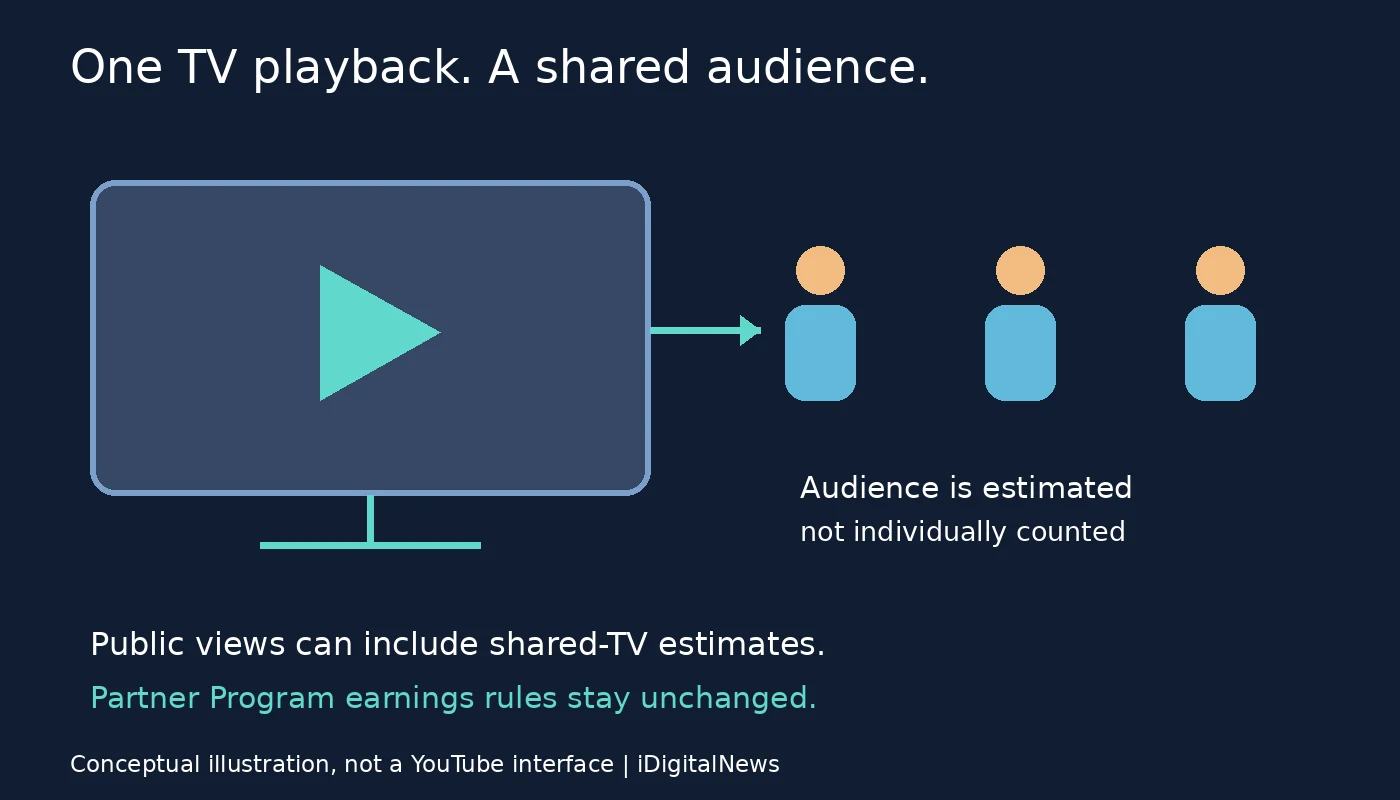
Featured graphic: original iDigitalNews explanatory illustration, not a product screenshot.
What YouTube Co-Views actually change
YouTube’s official engagement-metrics documentation says public video-page counts incorporate co-viewing estimates for TV screens. It also says views are counted when a video starts across Shorts, long-form videos and live streams. These statements describe the counting system, not a promise that every start represents a separate, fully engaged individual. A shared living-room screen is the reason this distinction matters: the device records a playback, while several people may be watching it. The estimate attempts to address that gap without making a public view count equivalent to an exact census.
An estimate is not a headcount
In 9to5Google’s report of the announcement, YouTube describes a statistical model informed by demographic patterns and viewing times, calibrated against sources such as industry panels. The report quotes YouTube saying cameras and microphones are not used. That is the platform’s explanation of its methodology, not an independent audit of it. Do not infer that YouTube has identified each person sitting on a sofa. Likewise, a higher reported figure does not tell a creator the names, interests or purchasing intent of additional co-viewers. Estimated shared viewing and individually observed activity answer different questions. This counting change is separate from YouTube app-to-TV casting and account pairing, which concerns how playback reaches a television rather than how its audience is estimated.
Why more public views do not automatically mean more revenue
The official help page explicitly says the change does not affect YouTube Partner Program earnings or eligibility. It distinguishes engaged views and engaged watch hours used for earnings from qualified views used for eligibility. That separation is more useful than a blanket claim that all views have the same financial value. A public number can describe estimated audience exposure while the payment system applies separate rules. Creators should therefore avoid multiplying any increase in displayed views by an old revenue-per-view figure and calling the result expected income. Without checking the denominator and the monetization definition, that calculation mixes unlike measures.
A simple example of the comparison problem
Imagine a fictional channel whose TV playback activity stays the same while its public count rises after shared-viewing estimates are incorporated. That observation alone cannot establish that its videos became more popular, its thumbnails improved or its audience watched longer. Part of the difference could be the counting method. Equally, unchanged earnings would not by itself show a payment failure: YouTube says those earnings rules are not changing. This is an illustrative scenario, not a forecast or a fixed multiplier supplied by YouTube. The useful lesson is to separate an apparent audience change from an actual change in behavior before rewriting a channel strategy.
How to explain the change in a brand report
Label public views as public views and include the reporting dates, rather than silently presenting them as unique people or paid engagements. Compare TV-heavy content with similar content and explain when a measurement change affects the comparison. Keep revenue, watch time and eligibility evidence in separate columns. If a sponsor asks whether a jump proves a campaign delivered more individual customers, the answer requires conversion evidence, not just the view counter. This is especially important when a presentation combines TV and mobile consumption. According to the announcement coverage, the new shared-viewing treatment applies to TVs, while mobile and desktop playback counting remains unchanged.
Check the definitions before troubleshooting a stalled count
YouTube says engagement counts can be slowed, frozen or adjusted while it verifies legitimacy, and that real-time estimates may differ from the watch page. Running the same video across many devices or windows is not a reliable way to validate the system; the help page identifies such behavior as an example of low-quality playback. For this rollout, the practical takeaway is narrower: use public counts to describe the platform’s reported reach, and use the relevant monetization metrics to explain earnings.