Nest Thermostat December Update: Sensors and Savings
Summary
The Nest Thermostat December update announced by Google on November 17 separates two benefits that are easy to confuse: estimated cumulative energy savings and support for compatible third-party room sensors. The first is an informational feature; the second concerns how a supported thermostat can account for temperatures elsewhere in a home. As of November 18, these are announced December changes, not features every owner should expect to find already enabled.
What the Nest Thermostat December update promises
In its official Google Home announcement, Google says Nest thermostat owners in the United States and Canada will be able to check estimated cumulative savings in the app starting in December. It separately specifies the fourth-generation Nest Learning Thermostat for balancing hot and cold spots using compatible third-party room sensors. Those qualifications matter. The post does not establish that every thermostat sold under the Nest name will gain the sensor capability, or that the savings feature is launching in every country. Check the exact product rather than treating the brand name as a compatibility statement.
Estimated savings are not a utility bill credit
A dashboard showing estimated cumulative savings is useful context, but it is not the same thing as a guaranteed reduction in the next bill. Google’s announcement describes an estimate and does not establish a specific saving for an individual household. A sensible comparison keeps the estimate beside actual utility consumption and tariff information, not in place of them. Weather, occupancy and changes in energy prices can complicate a simple before-and-after bill comparison. Those are general considerations for interpreting energy data, not additional capabilities Google has announced for this dashboard. Do not purchase a thermostat on the assumption that the displayed estimate is money you will necessarily receive.
Buying a room sensor requires two compatibility checks
First confirm that the thermostat is the fourth-generation Nest Learning Thermostat identified in the announcement. Then confirm that the exact sensor model, not merely its manufacturer, is supported. 9to5Google’s coverage names IKEA, Eve and Aqara among compatible brands, but that should not be read as blanket support for every product those companies sell. The primary announcement does not provide a complete accessory compatibility matrix or a universal setup procedure. Wait for model-specific documentation before buying a sensor solely for this update, especially if you are importing hardware or mixing products from different regional catalogs.
A room sensor does not create an independent heating zone
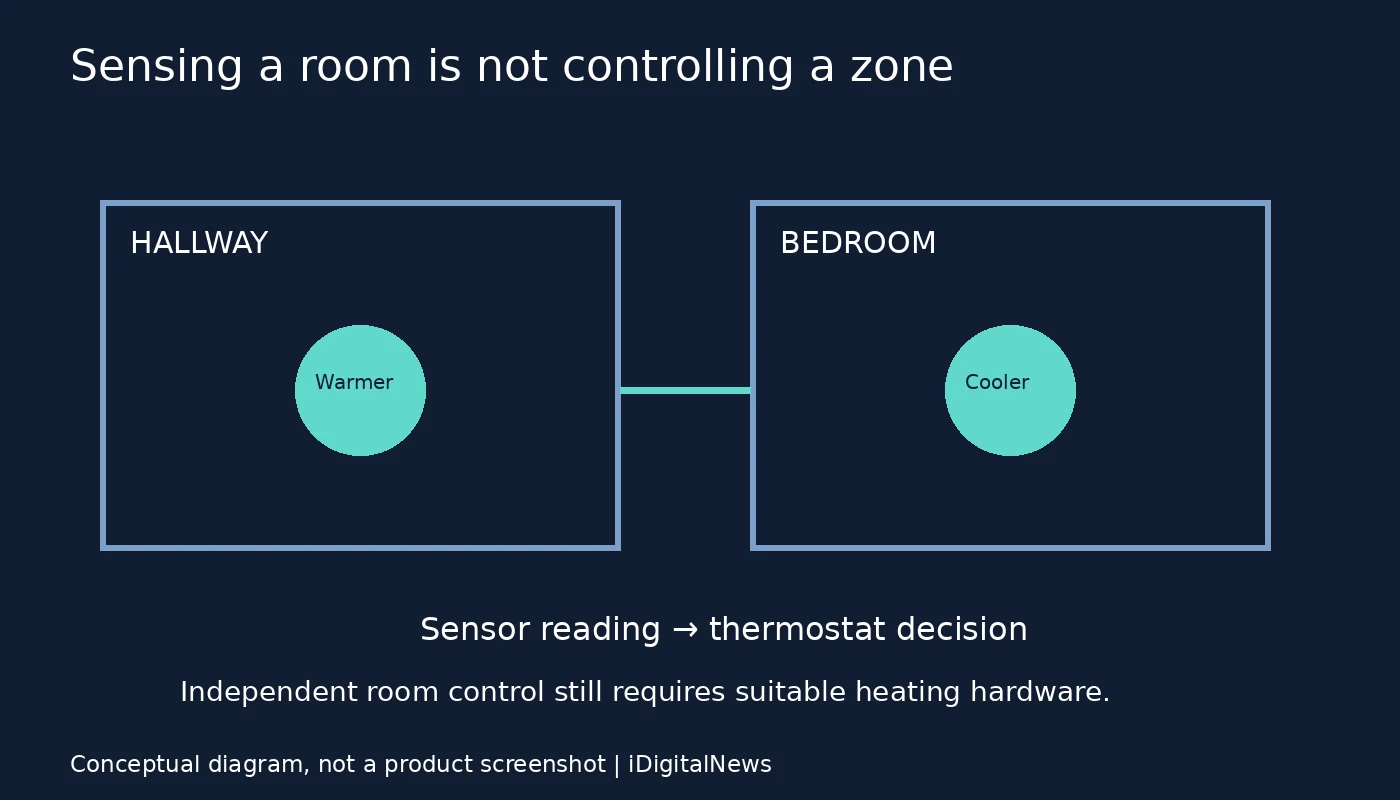
A temperature sensor can provide a reading from a different part of the home. That does not, by itself, add a motorized valve, a separate heating circuit or independent room-by-room control. Consider a hypothetical home where a hallway is warmer than a bedroom. A bedroom reading can help describe that mismatch, but the result still depends on what the heating system can physically control. This is a general explanation of sensing versus actuation, not a tested account of Google’s new implementation. Google’s announcement does not settle every question about scheduling, weighting or how multiple third-party readings will be used.
Other Google Home changes have different requirements
The same announcement describes digital home keys in Google Wallet, audio descriptions for motion-triggered camera events and faster Gemini for Home responses. These are not all thermostat features. Audio descriptions are associated with Google Home Premium Advanced, while digital entry requires compatible locks. Google says everyday Gemini for Home requests are up to 20% faster; that is a vendor claim, not a speed measurement from our testing. The company also says Gemini for Home is expanding to six more countries, including India and Brazil. Do not assume a rollout statement about voice assistance changes the United States-and-Canada limitation stated for the savings feature.
What owners can check before December
Record the exact thermostat generation and the country associated with the installation. Keep the app updated, then consult the official rollout and accessory documentation when the feature becomes available. If the new controls are absent on the first day of December, the announcement alone does not establish that the installation is broken or that a reset is needed. Owners considering broader smart-home changes should also distinguish this heating update from the separate Pixel Family Hub sharing controls: a household feature does not automatically share every kind of data or device access. The decision today is to verify compatibility and wait for the documented rollout, not to buy an unconfirmed accessory on a headline alone.