GPT-6.2 Astra vs Sol: Compare Costs Before Switching
Summary
GPT-6.2 Astra vs Sol is a choice between a higher-priced frontier model and a cheaper everyday-work model, not simply between two versions of the same subscription. OpenAI’s November 18 announcement positions Astra for difficult professional projects and Sol for efficient general work. The practical question is whether a more expensive model produces an acceptable result with less total effort. A lower token price alone cannot answer that question, and neither can a headline benchmark score.
Featured graphic: original iDigitalNews explanatory illustration, not a product screenshot.
GPT-6.2 Astra vs Sol: the published API rates
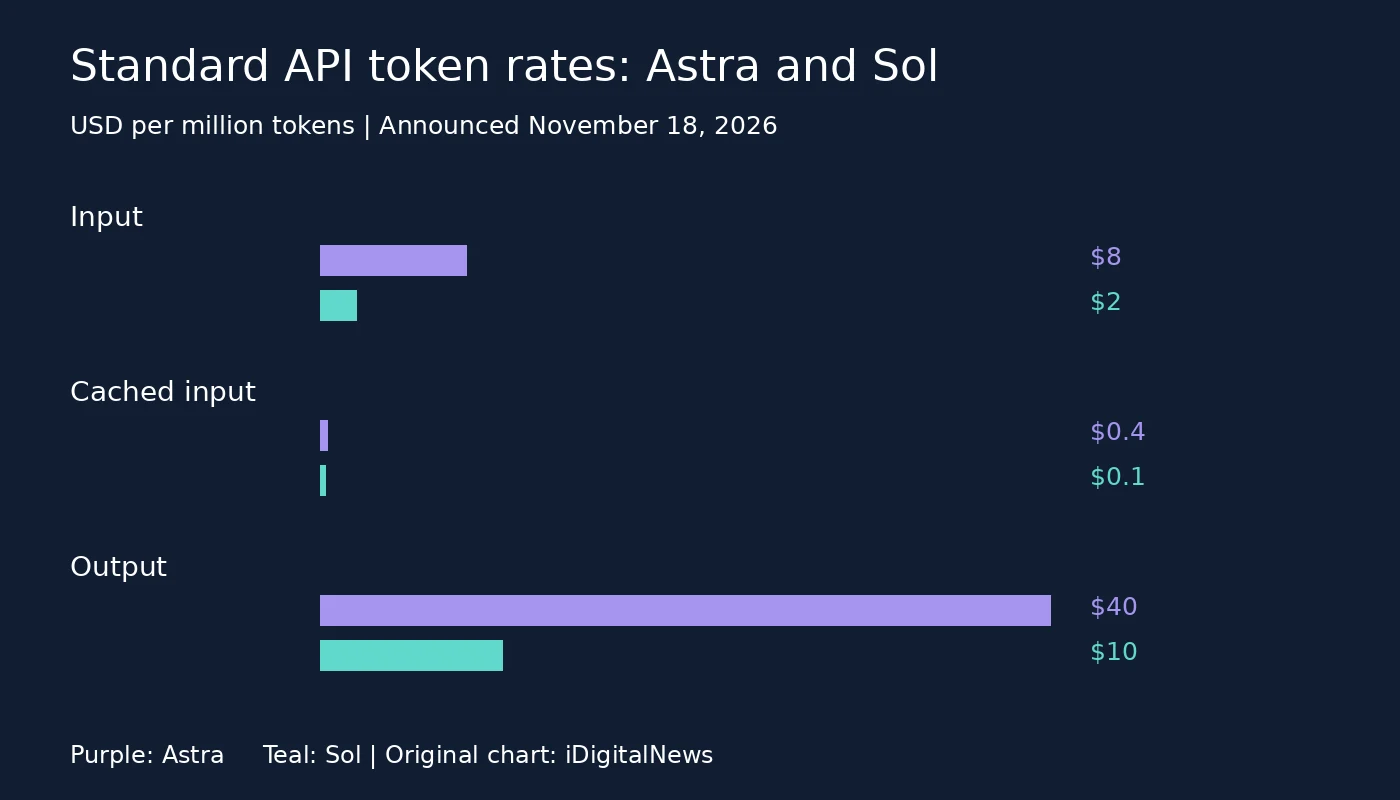
According to OpenAI’s launch announcement, standard Astra rates are $8 per million input tokens, $0.40 per million cached input tokens and $40 per million output tokens. Sol costs $2, $0.10 and $10 respectively. At these standard rates, each listed Astra token category costs four times the corresponding Sol category. These are API rates, not the price of a ChatGPT subscription or a promise about how much work an account can complete. OpenAI says Sol retains GPT-6.1 Sol pricing while Astra’s ordinary input and output rates fall 20% from GPT-6 Astra.
A worked cost example, not a performance prediction
Consider an illustrative request with 100,000 uncached input tokens and 10,000 output tokens. Astra’s token charge would be $0.80 plus $0.40, or $1.20. Sol’s would be $0.20 plus $0.10, or $0.30. If all 100,000 input tokens qualified as cached input instead, the same arithmetic gives $0.44 for Astra and $0.11 for Sol. These are hypothetical calculations using the announced standard rates, not measurements from a test. They exclude tool charges and other billable services. Real tasks can generate different token counts, require retries or use different service options. Do not treat the four-to-one rate ratio as a guaranteed four-to-one difference in the final project bill.
Why token efficiency is different from token price
OpenAI says both models complete demanding tasks with fewer output tokens. It also reports stronger results on professional-work, coding and science evaluations. Those are vendor-reported results under particular evaluation conditions; this article has not independently reproduced them. A model that costs more per token could still cost less per accepted deliverable if it avoids failed attempts. Conversely, a cheaper model can be the better purchase when it already meets the brief. For a spreadsheet task, check formulas and source references rather than just the presentation. For a code change, check behavior and maintainability rather than counting generated lines. The acceptance criteria should determine the winner.
Run a bounded comparison before moving production work
Choose several representative jobs with outcomes you can assess: a document that must follow a template, a repository change with clear expected behavior, or an extraction task with known answers. Keep the brief and source material the same for both models. Record input and output token usage, retries, tool spending and the human review needed to accept the result. Treat missing facts or incorrect calculations as failures even when the output looks polished. This is a proposed evaluation method, not a claim that we tested either model. It makes the comparison relevant to your own workload rather than assuming an aggregate leaderboard settles it.
Availability, caching and safeguards need separate checks
As of the launch announcement, OpenAI says the models are available in ChatGPT Work and Codex for Plus, Pro, Enterprise and Edu users, and through the API as gpt-6.2-astra and gpt-6.2-sol. Enterprise and Edu access can depend on administrator enablement. OpenAI recommends preserving prompt prefixes and appending new instructions to improve cache reuse; do not assume every request receives cached pricing. The company also describes tighter safeguards for higher-risk cybersecurity assistance. A benchmark obtained under a special testing configuration is not proof that the same request will be supported in a normal deployment.
Choose on accepted output, not a model label
Start with Sol when your existing evaluation shows that it meets the task reliably. Escalate difficult cases to Astra when the added quality or fewer retries justifies the higher rate. That is an editorial decision framework, not a guarantee that either model will pass a particular job. Keep sensitive material subject to your organization’s controls regardless of model choice; changing models is separate from deciding how an AI service retains conversation data. Before migrating a production workflow, verify account access, actual billing and the failure cases that matter to your users.