MedChemBench: Why an 84.5% Score Is Not Drug Discovery

Summary
MedChemBench evaluates how AI models reason about medicinal chemistry, not whether they can independently discover a safe and effective drug.
OpenAI introduced the benchmark on November 20, 2026, and reported 84.5% of available credit for GPT-6.2 Astra at its xhigh reasoning setting.
That is a benchmark result from the developer, not a clinical success rate or the probability that a suggested compound will become a medicine.
Featured image: OpenAI, MedChemBench announcement figures.
What MedChemBench asks models to do
The OpenAI announcement describes 99 problems drawn from 117 papers and patents, covering 761 distinct molecular structures. Models generally receive a research goal, structures, earlier compounds and selected experimental findings. Their job is to interpret that evidence at a particular stage of a historical research program. Four components separate the work: reconstructing molecular structures, explaining scientific evidence, ranking or choosing compounds, and predicting properties.
These are related skills, but a model that reads a structure correctly is not automatically good at selecting the best next experiment.
Read the headline score with its denominator

OpenAI reports 84.5% for GPT-6.2 Astra, 83.3% for GPT-6 Astra, 82.0% for GPT-6.1 Sol and 58.2% for GPT-5.6 Sol at xhigh.
The figures represent shares of available credit, with partial credit in relevant tasks. They should not be rewritten as percentages of drugs discovered or even as a simple count of fully solved problems. Data Phoenix’s coverage also distinguishes the announcement’s newer-model result from the accompanying preprint, which does not include GPT-6.2 Astra. Those are different reporting artifacts, not interchangeable versions of one leaderboard.
Why a molecule can be strong and still be a poor choice
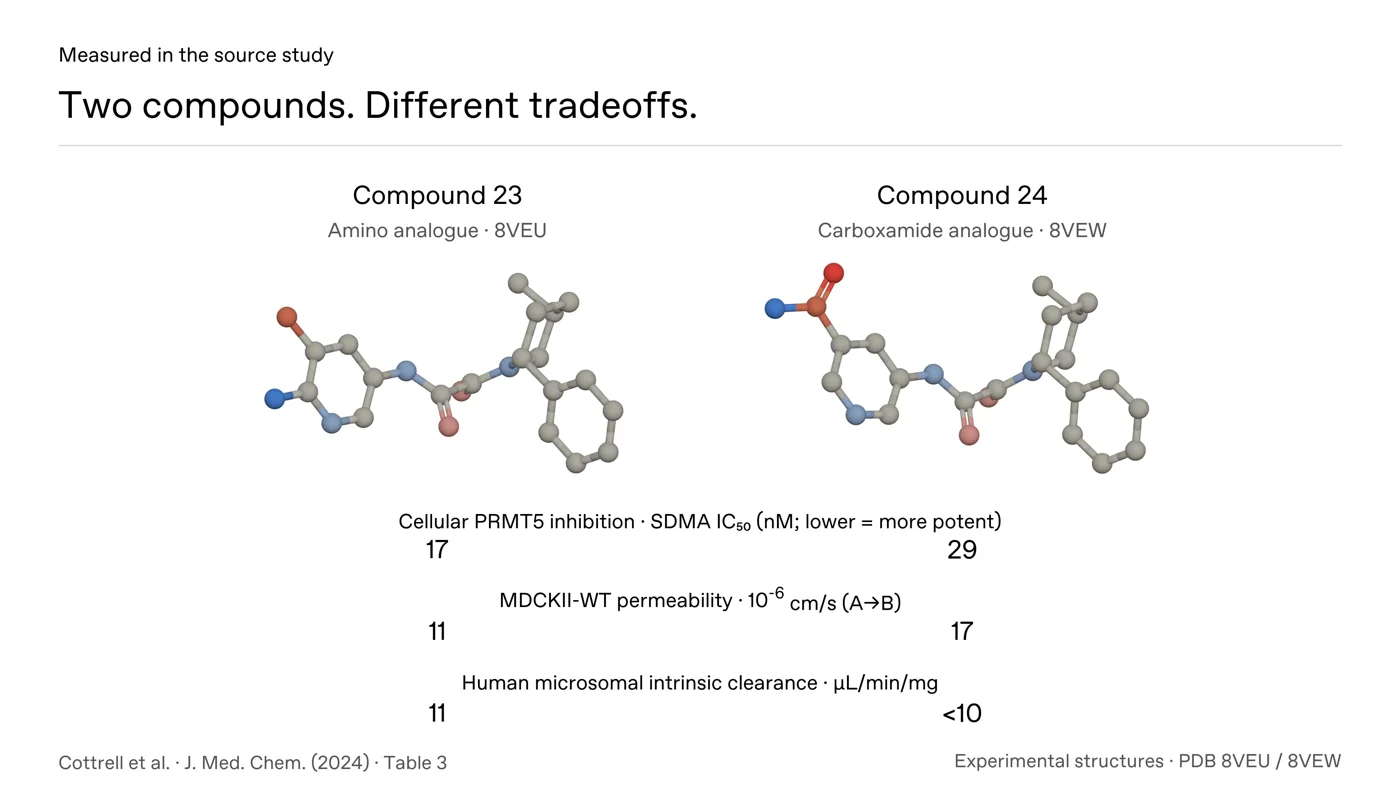
One example involves inhibitors of PRMT5, a protein studied in cancer drug research. Models are asked to predict cell-based activity, permeability and breakdown in a liver-enzyme assay. In the withheld experimental results, compound 23 inhibited PRMT5 in cells at a lower concentration, while compound 24 crossed the cell barrier more readily and broke down more slowly in the assay.
The practical lesson is a multi-property tradeoff: stronger activity in one measurement does not establish a superior medicine. Neither result by itself proves clinical benefit, acceptable toxicity or a suitable human dose.
Structure recognition is a different bottleneck
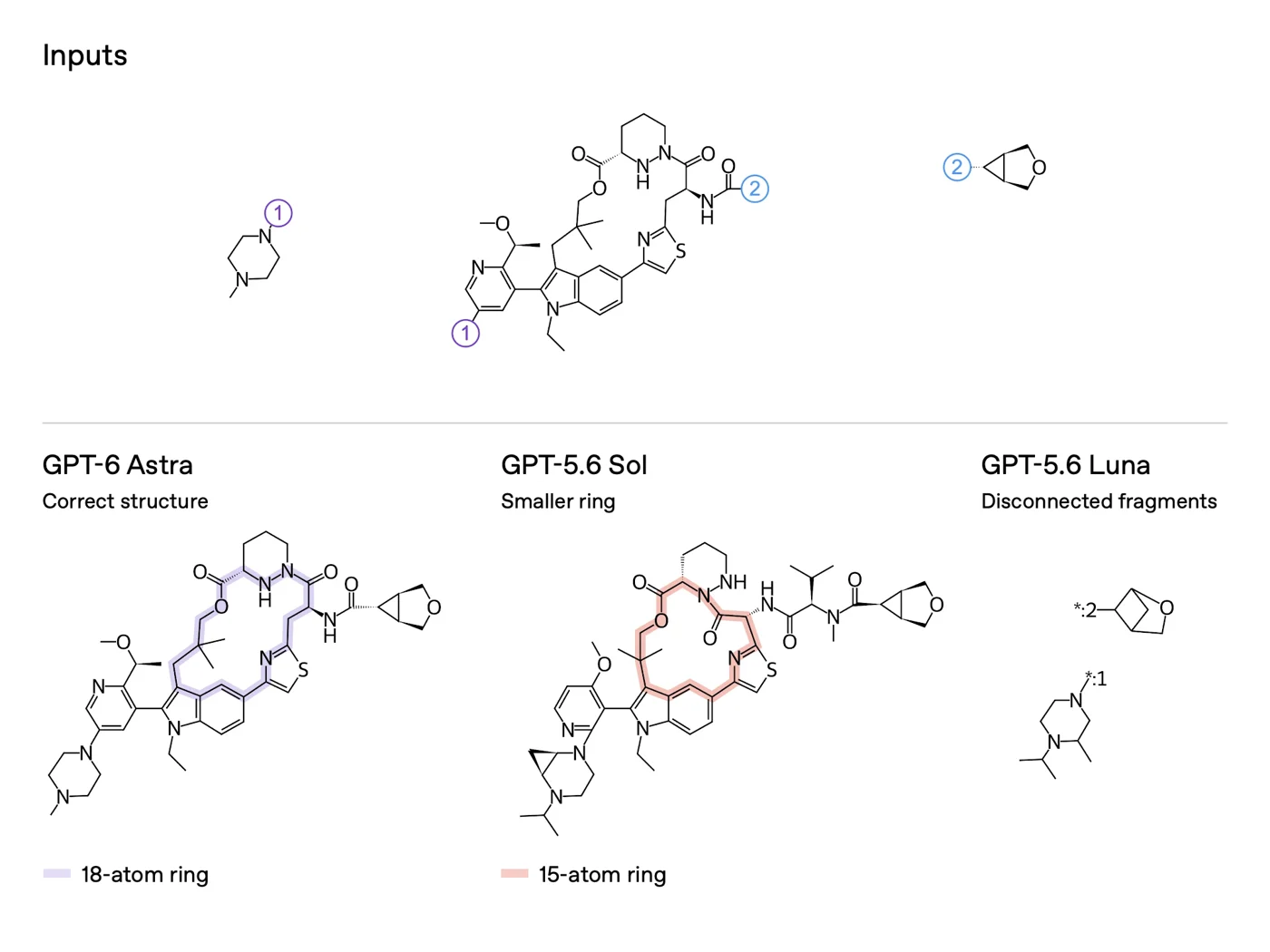
The announcement describes a reconstruction task involving an 18-atom ring. In the cited example, GPT-6 Astra preserved the ring across ten responses at xhigh, while older models produced a smaller ring or disconnected fragments. Such an error changes which molecule is under discussion before any biological reasoning begins.
OpenAI reports 95.4% of available structure credit for GPT-6 Astra at xhigh, but only about half the credit on compound selection and numerical property prediction.
These components use different tasks and grading rules, so their percentages should not be treated as identical measures. Still, the separation is more informative than the overall score alone.
A checklist for evaluating a chemistry AI claim
For a lab or technical buyer, start by asking which task the claimed result measures. Is the system transcribing structures, explaining supplied evidence, ranking candidates or predicting measurements? Next ask whether the data were genuinely unseen, whether external tools were allowed, and how predictions were checked. Finally, ask for a prospective test on the actual research setting. This is an evaluation checklist inferred from the benchmark’s limitations, not evidence that a particular commercial product has passed it.
A proposal to use AI for organizing hypotheses should be judged differently from a claim that it can autonomously choose synthesis targets.
What the benchmark cannot establish
OpenAI explicitly says prior exposure to the published material cannot be ruled out. Each response was a single attempt without tools, feedback or new experiments.
The test therefore cannot demonstrate real-world improvements in laboratory decisions or successful discovery of new drugs. Historical questions can reveal reasoning weaknesses, but they do not replace prospective experiments.
The reviewed announcement does not establish an independent replication of the scores. Treat the figures as vendor-reported evidence with a defined scope, not as a general endorsement of unsupervised use in medicinal chemistry.
Keep model choice separate from scientific validation
Readers comparing the model families can also consult our Astra and Sol cost comparison, but price and benchmark performance answer different questions.
A cheap response that misidentifies a structure can be unusable; an expensive high-scoring model still needs evidence checks.
The defensible conclusion from MedChemBench is narrower than the drug-discovery headline: models show substantial ability on structure reconstruction and explanation, while selection and prediction remain harder. What matters next is whether those abilities survive evaluation on new research and improve decisions verified by experiments.