Bitcoin Wallet IP Leak: What the 30-Test Result Means

Summary
A Bitcoin wallet IP leak study shows how transaction rebroadcasting can connect an address to the node watching it. The result is a privacy concern, not evidence that private keys were stolen. Researcher Abubakar Sadiq Ismail reported 30 successful address-to-node attributions in a controlled regtest experiment; that is not a measured success rate on Bitcoin’s live network.
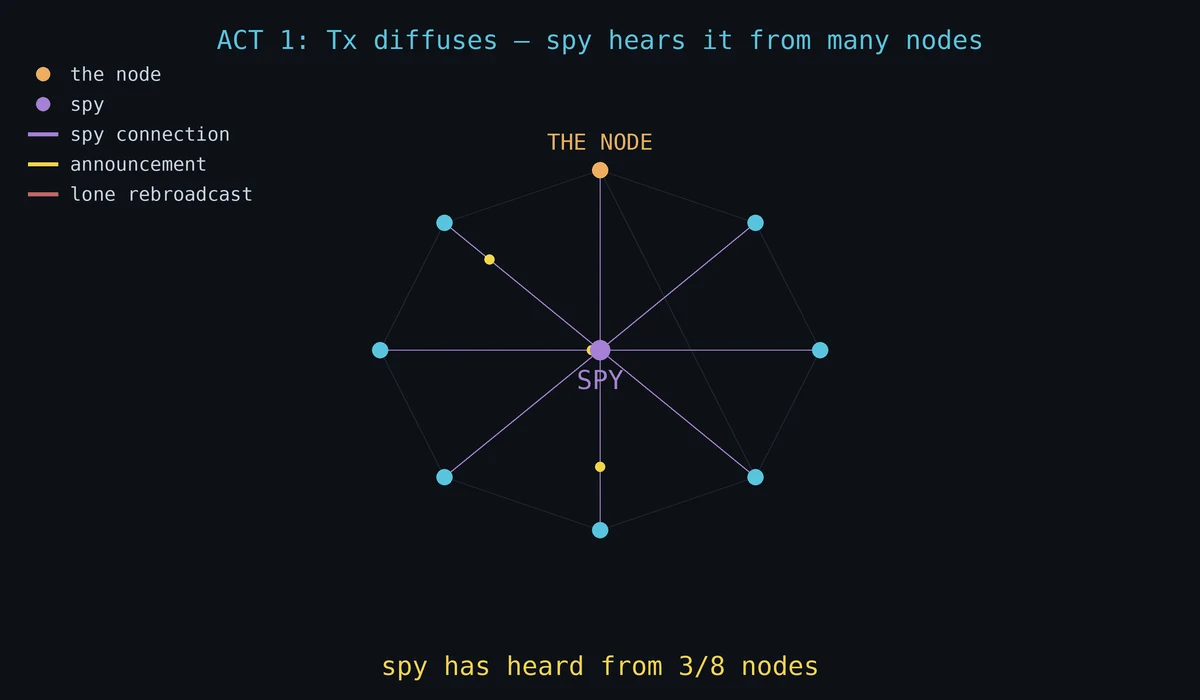
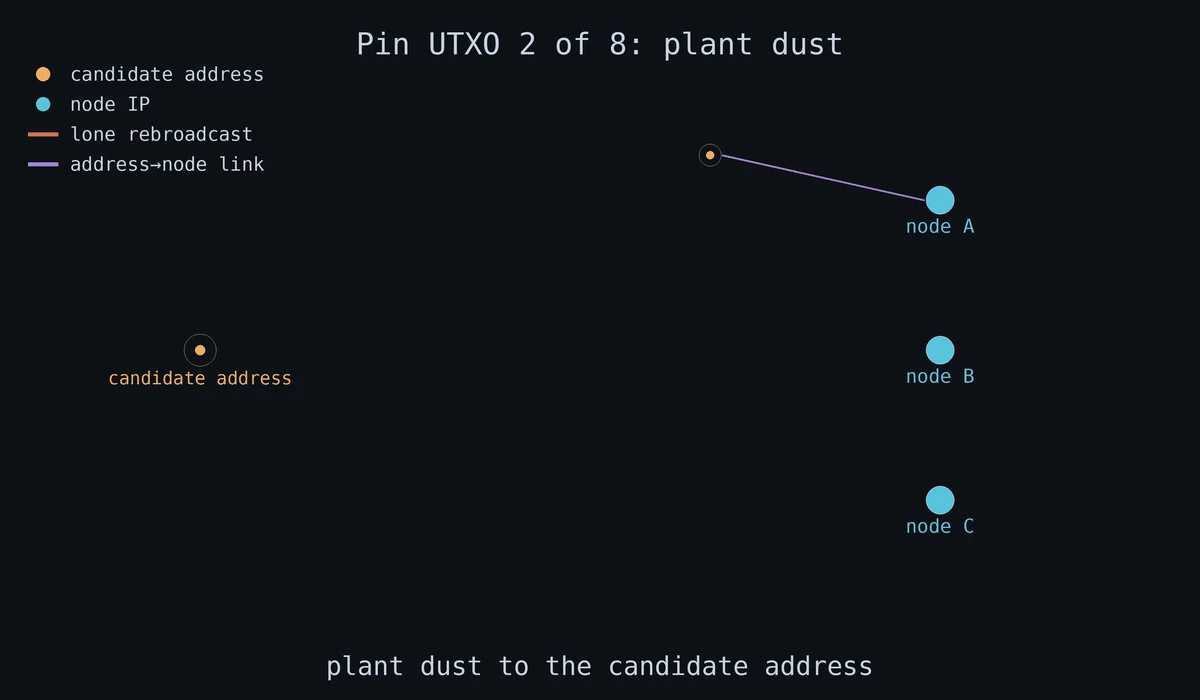
Featured image: Abubakar Sadiq Ismail / Delving Bitcoin. Still frame from the researcher’s animation, not a live-network measurement.
Where the Bitcoin wallet IP leak comes from
In a November 25 developer-forum post, Ismail describes a long-known issue in Bitcoin Core wallet rebroadcast behavior. When an unconfirmed transaction remains in a wallet, the wallet can announce it again after roughly 12 to 36 hours. That includes incoming payments, not only transactions the wallet owner created.
An observer can exploit that behavior by sending a small, low-fee payment to an already-used address and observing which candidate node later announces it. The revealing action is the wallet recognizing and rebroadcasting the payment. Merely relaying transactions is not equivalent to running a wallet that tracks the address.
The threat requires network observation and suitable connectivity to candidate nodes, as well as time for the rebroadcast interval. A very small payment cost is therefore not the total operational cost of the attack. Infrastructure, reachability, transaction confirmation and network conditions all affect what an observer can learn.
What 30 out of 30 does—and does not—prove
The researcher tested five target wallets across six trials using stock Dockerized Bitcoin Core nodes on regtest, a controlled Bitcoin testing environment. A fresh observing peer identified the correct tracking node in all 30 attributions. That demonstrates the mechanism under the stated configuration.
It does not show that every reachable wallet on mainnet can be identified with certainty. Real networks introduce different mempool contents, peer availability, transaction confirmation behavior and additional announcements. The post itself discusses how a relay that evicts a transaction can later treat it as new, creating a secondary signal.
The quoted payment estimates are also conditional. Ismail modeled approximately 309 to 569 satoshis per planted transaction, including the output and relay fee, with dollar conversions based on roughly $59,000 per bitcoin on November 25. Those dollar values are not a standing fee quote or a live bitcoin price.
A watched address does not establish ownership
One of the most consequential details is that watch-only wallets can produce the same signal. Such a wallet tracks an address without holding its private key. An association between an address and a node therefore does not prove that the node operator controls the coins.
Consider a hypothetical monitoring service watching several customer addresses. Linking those addresses to that server would reveal a shared monitoring point, not necessarily a common beneficial owner. Analysts should preserve that distinction when interpreting clusters or drawing conclusions about a person.
The research lists integrations potentially exposed when they load addresses into a Core wallet, including Sparrow’s Core mode, Specter and Liana’s bitcoind backend. That is a configuration-dependent claim, not a finding that every mode of every listed wallet is affected. Users should establish their actual backend before assuming a product name settles their exposure.
Why mitigation changes require care
The post describes disabling wallet broadcasting with -walletbroadcast=0. The trade-off is broader than stopping periodic rebroadcast: wallet-initiated relay of newly created outgoing transactions is disabled too. Users would need a deliberate alternative broadcasting workflow. This is not a setting to change casually while expecting normal sending behavior to continue unchanged.
A node using Tor or I2P can still expose a clearnet IP if it also maintains ordinary internet peers and rebroadcasts over those connections, the researcher explains. Restricting network use can avoid that particular clearnet association, but an address may still become linked to an onion or I2P identity. Network privacy and wallet privacy are related, not interchangeable.
The proposed Bitcoin Core change #36482 limits rebroadcast to transactions newly added to the mempool. The discussion does not establish a released fix as of November 27. Contributor Martin Zumsande argues that adapted attacks remain possible and recommends additional changes concerning received payments. Treat the pull request as engineering work under discussion, not a complete privacy guarantee.
A useful exposure check for node operators
Begin with three questions: does your setup load watched addresses into a Core wallet; does it maintain clearnet transaction-relay connections; and is wallet broadcasting enabled? Document those answers before selecting a mitigation. An exchange-hosted balance or a wallet using another backend cannot be diagnosed from this experiment alone.
Keep the scope of the result separate from other Bitcoin software issues. Our coverage of a separate Bitcoin Core node-stall vulnerability follows both privacy and availability risks, but a rebroadcast association is neither a consensus failure nor proof of lost funds. No mainnet exploitation rate or firsthand reproduction is claimed here.
For a privacy-sensitive deployment, review the primary discussion with whoever operates the node and verify how outgoing transactions will be relayed after any configuration change. The immediate reader takeaway is narrower and more useful than ‘Bitcoin is deanonymized’: a specific wallet behavior can expose a monitoring relationship, and both the experimental limits and mitigation trade-offs matter.