DTCC Solana Tokenization: What the 2027 Plan Actually Changes

Summary
DTCC Solana tokenization is a planned expansion of securities infrastructure, not a live invitation to buy every US share from a crypto wallet. In its November 12, 2026 announcement, DTCC said it expects eligible DTC-custodied assets to become available on Solana in the second half of 2027. The distinction between a future network connection and an available investment product is the most important part of the news.
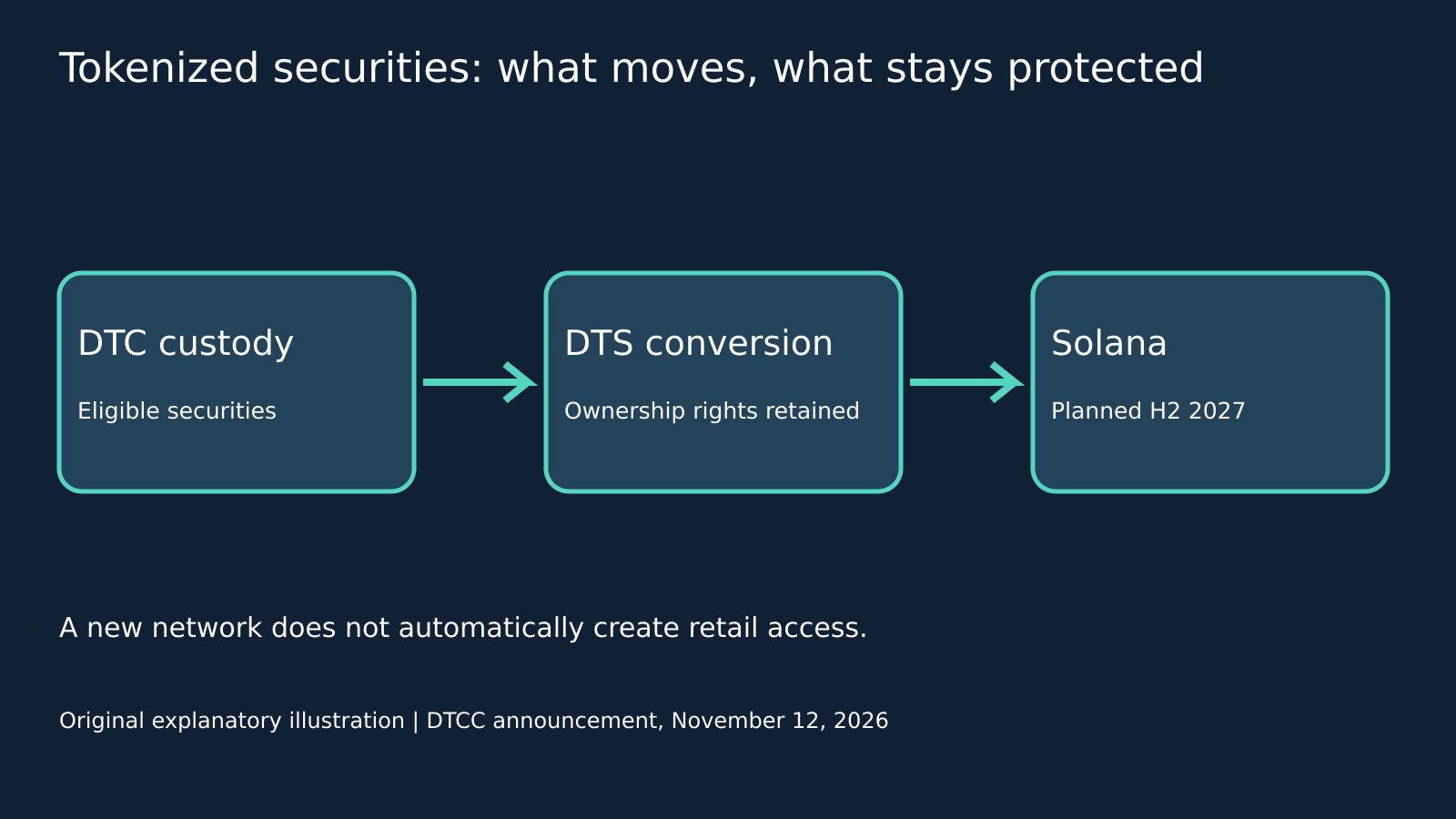
Featured image: Original explanatory illustration by iDigitalNews, not a product interface.
What DTCC announced, and when
The Depository Trust & Clearing Corporation plans to connect its DTCC Tokenization Service, or DTS, to Solana’s layer-one network. DTCC says the service launched on October 28 and describes the Solana connection as a further step in a multi-chain strategy. The announced integration is expected in the second half of 2027; it is not described as already operational on Solana. See the primary announcement for the documented details.
DTC, the Depository Trust Company, is the custody subsidiary named in the announcement. The plan concerns eligible assets held there and their conversion into tokenized form, together with token lifecycle functionality. It does not say that every security held at DTC is automatically eligible, that every blockchain token representing a stock is part of DTS, or that all investors can participate through any wallet.
DTCC Solana tokenization is not just a new ticker
A useful way to read the announcement is to separate three layers. The first is the underlying eligible security and custody arrangement. The second is the service handling conversion and token lifecycle. The third is the blockchain on which the tokenized asset can be accessed and used. The Solana announcement changes the planned network options, not simply the name of an asset.
DTCC says tokenized assets made available on Solana, and other integrated networks, will retain the investor protections, ownership rights and regulatory safeguards that apply to traditionally held securities. That is a central feature of its stated design. It should not be generalized to unrelated synthetic or derivative tokens that happen to track the price of the same company.
Before comparing two tokenized products, ask what the holder legally owns, who maintains the ownership record, what redemption or conversion process exists and which intermediary is responsible. Similar trading screens or price charts do not answer those questions. This is a due-diligence framework, not a legal conclusion about a particular token offering.
Why custody totals are not tokenized market size
DTCC’s announcement says its depository subsidiary provided custody and asset servicing for securities valued at $114 trillion in 2025. That figure describes the wider custody business. It is not a claim that $114 trillion has been tokenized, moved to Solana or become available to retail investors. For a separate but related development, see our coverage of the NYSE-affiliated Avalanche settlement plan.
The same release cites $4.7 quadrillion of securities transactions processed by DTCC subsidiaries during 2025. A transaction-flow total is also different from the value of assets held at a particular moment. Confusing flows, custody values and outstanding tokens can make an infrastructure announcement sound much larger than the actual deployment being described.
The release does not provide a live Solana tokenized-asset balance because the connection remains planned. For future progress checks, look for evidence of supported assets, participant access and actual service operation rather than treating the scale of DTCC’s existing business as a deployment metric.
What investors and institutions should watch next
For institutions, DTCC presents the integration as a way to expand choice and improve interoperability, collateral mobility and capital efficiency. These are intended benefits. The announcement alone does not demonstrate a measured reduction in settlement costs or guarantee that liquidity will automatically be identical across networks.
For individual investors, the useful next checks are product-specific: whether a regulated broker or platform offers access, which jurisdictions are supported, what fees and transfer restrictions apply, and whether the rights match the underlying security. The November 12 release does not answer every one of those questions, so it would be premature to publish a step-by-step retail buying guide from it.
The announcement also is not a price forecast for SOL. A network’s planned use in regulated infrastructure and the investment performance of its native token are different questions. As of November 13, the confirmed story is a roadmap commitment with a second-half 2027 target. Actual availability, participating services and operational terms remain the milestones to verify as implementation progresses.