




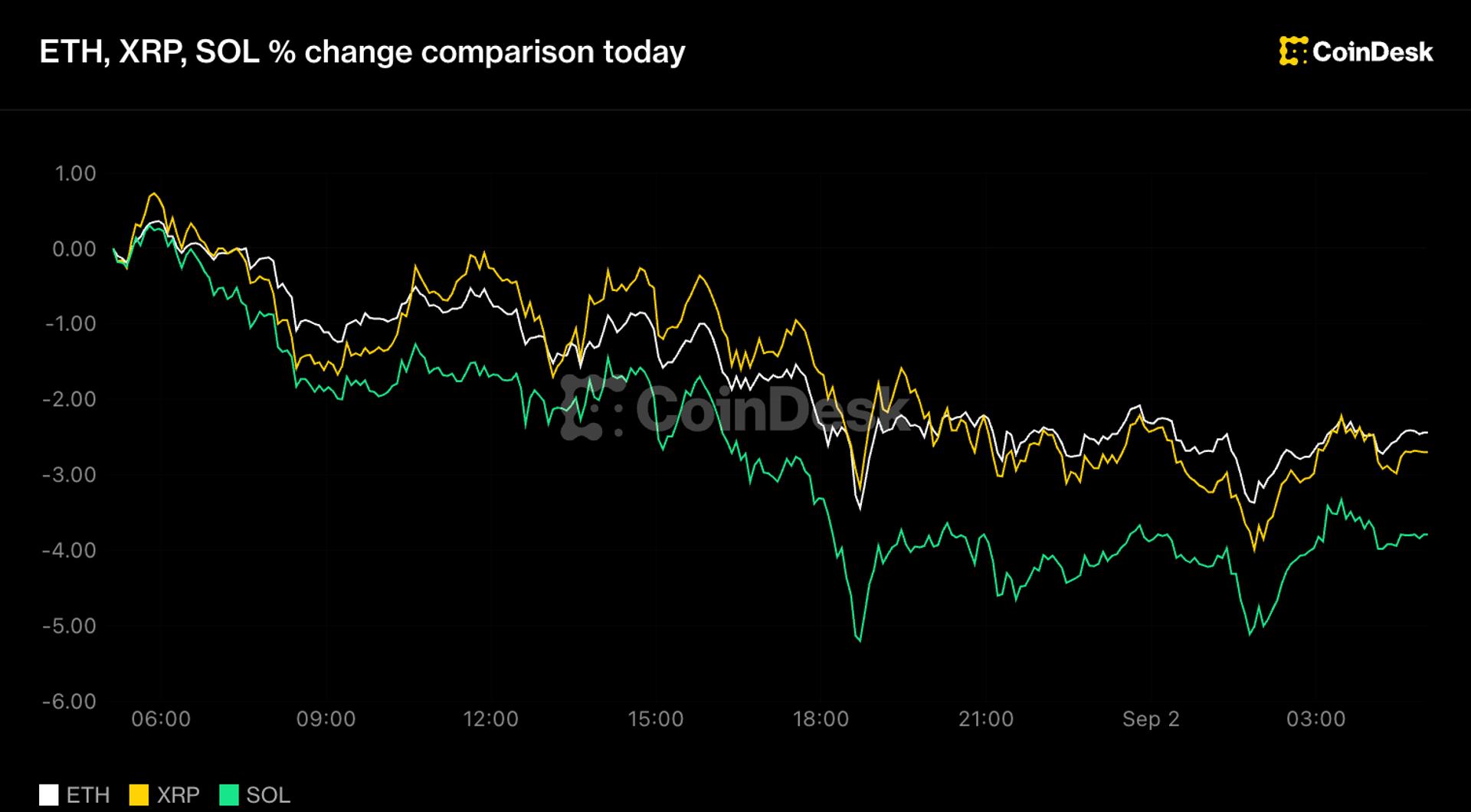
Crypto majors slide across the market after geopolitical tension and macro pressure triggered a broad risk selloff. According to CoinDesk’s latest market feed, Solana, Ether and XRP led the decline among major tokens as Iran strikes added to pressure from oil prices, bond yields and a firm US dollar.
The move shows how quickly digital assets can react when global markets shift away from risk. Crypto often trades as a high-beta asset class during stress, meaning smaller changes in macro sentiment can produce larger moves in tokens. In this case, CoinDesk reported that every large-cap token fell over the past 24 hours, while high-beta majors gave up roughly triple what Bitcoin lost.
Why Solana, Ether and XRP fell harder
When crypto majors slide, Bitcoin often acts differently from the rest of the market. It is still volatile, but it has deeper liquidity, more institutional awareness, and a stronger role as the benchmark crypto asset. Solana, Ether, XRP and other large-cap tokens can move more aggressively because traders often treat them as higher-risk expressions of the same market view.
That dynamic becomes sharper during geopolitical shocks. If investors are worried about oil, inflation, rates, or military escalation, they tend to reduce exposure to assets that can move quickly against them. Tokens with stronger recent rallies, higher leverage, or thinner liquidity can fall faster as traders cut positions.
CoinDesk’s feed also pointed to $90 oil and rising yields as part of the broader market backdrop. Higher oil prices can add inflation pressure. Rising bond yields can make speculative assets less attractive because investors can earn more from safer instruments. A firm dollar can create another headwind because many global investors price risk assets against the US currency.
Bitcoin’s relative strength does not remove risk
Bitcoin reportedly held up better than several other major tokens, but that should not be mistaken for immunity. Bitcoin can still trade choppily when macro pressure builds. The difference is relative performance. In a selloff, Bitcoin may fall less than higher-beta tokens while still reflecting stress across the market.
This is a pattern crypto investors have seen before. In strong risk-on periods, altcoins can outperform Bitcoin because traders are willing to chase higher returns. During risk-off periods, the same assets can underperform because liquidity retreats toward the market’s largest and most established token.
The current setup therefore gives investors two signals at once. First, digital assets remain sensitive to macro and geopolitical shocks. Second, internal rotation still matters. A market can be broadly weak while some tokens fall much harder than others.
What the selloff says about crypto’s maturity
The fact that crypto majors slide during a global risk event is not surprising. In many ways, it shows that crypto is now deeply connected to the same liquidity conditions that move stocks, commodities, currencies and bonds. Digital assets may be decentralized at the protocol level, but trading behavior is tied to global capital flows.
That connection cuts both ways. Institutional adoption can bring deeper markets, better custody, and more professional infrastructure. It can also make crypto more responsive to the same pressures that move traditional finance. When funds reduce risk across portfolios, crypto may be sold alongside growth stocks, emerging-market assets and other volatile positions.
For long-term investors, the important question is whether the selloff changes the underlying thesis for each asset. For short-term traders, the more urgent question is leverage. Fast declines can force liquidations, widen spreads, and create disorderly moves even when the original news is outside crypto itself.
What traders should watch next
The next signals are oil, yields, the dollar, and whether geopolitical tension eases or escalates. If oil stays high and yields continue rising, risk assets may remain under pressure. If the dollar strengthens further, crypto could face another headwind because global liquidity tends to tighten when the dollar rallies.
Inside crypto, investors should watch whether Bitcoin continues to outperform, whether Ether stabilizes, and whether Solana and XRP recover quickly or keep lagging. A fast rebound would suggest the selloff was mainly a short-term macro shock. Continued weakness would point to a broader reduction in risk appetite.
The headline is simple, but the lesson is deeper. When crypto majors slide during geopolitical stress, the market is reminding investors that token prices do not move in isolation. Crypto may be a new asset class, but it still trades inside an old world of oil shocks, interest rates, currencies and fear.
Source: CoinDesk