Shirudo eBPF Shields: A Bridge to Linux Patches

Summary
Shirudo eBPF shields are intended to protect a running Linux workload while its operators prepare a permanent patch. OpenAI and Cisco announced the open-source runtime on November 23, 2026, describing a controlled test in which a Codex-generated shield blocked a Java4Shell exploit attempt against Elasticsearch without a restart. That is a promising demonstration of targeted mitigation, not evidence that patching can be abandoned or that the system is ready for every production workload.
How Shirudo eBPF shields fit the patching gap
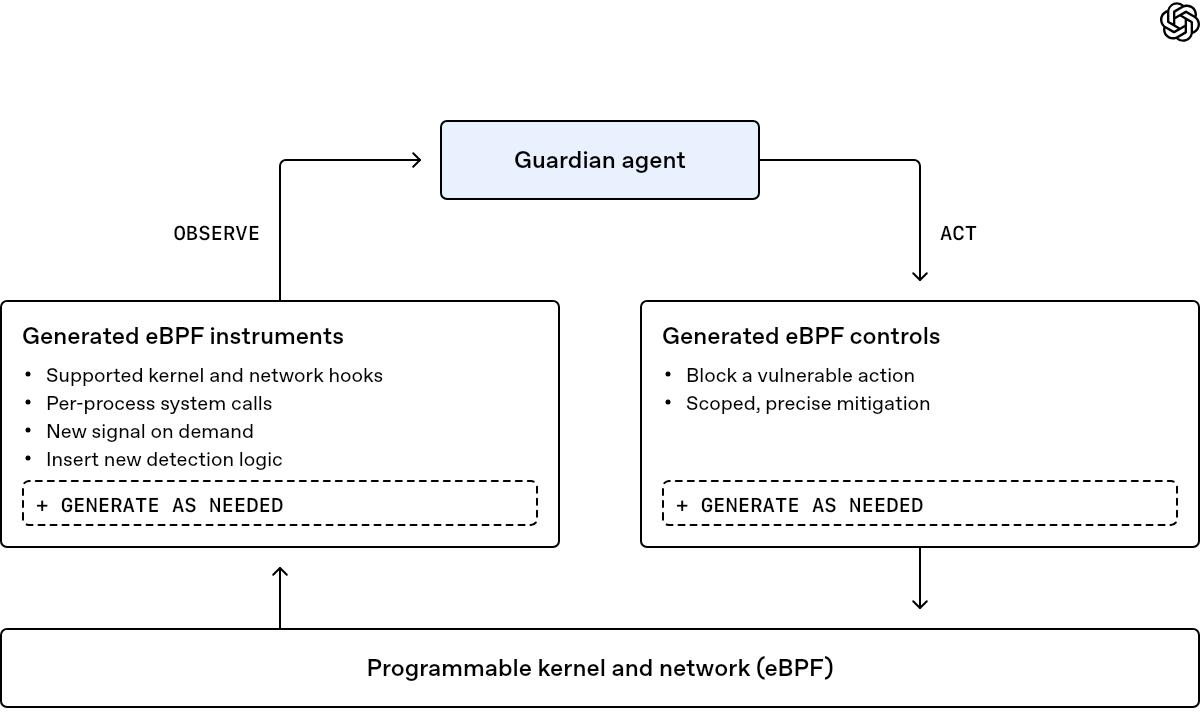
OpenAI’s architecture diagram shows observation and targeted eBPF controls. It describes the design, not an independent production benchmark.
The difficult period after a vulnerability becomes known is often the interval between identifying an affected service and safely rolling out its fix. Blocking a broad operating-system action may stop an exploit but also break legitimate work. According to OpenAI’s announcement, Shirudo is designed to make the intervention narrower: teams test a temporary safeguard against malicious behavior and legitimate requests, then an operator approves deployment while the service continues running. The shield is therefore best understood as a bridge to remediation. Its purpose does not remove the need to inventory affected versions, schedule the permanent fix and verify that the underlying vulnerability is gone.
What the Elasticsearch demonstration establishes
In the example described by OpenAI, Codex generated a shield that added an input check to Java’s Base64 decoder and attached it to a running Elasticsearch process. The malicious input was rejected while the service continued operating. The announcement identifies this as a controlled test and links to Cisco’s Isovalent account. We have not independently reproduced it. The available account does not establish a fleet-wide false-positive rate, performance overhead across unrelated services or protection against every route to the same vulnerability. Those missing measurements matter when moving from a demonstration to an operational decision.
Signed deployment and eBPF verification solve different problems
Shirudo uses eBPF, which lets small programs run at selected points inside Linux. OpenAI describes signed shields verified before loading, eBPF verifier safety checks and kernel security controls restricting unauthorized changes. These are distinct layers. A signature helps establish what code is authorized; it does not prove that the security rule is correct for a particular application. Passing the verifier’s safety rules likewise does not establish that legitimate requests will remain unaffected. A team still needs application-level tests, monitoring and a reversible rollout plan. Keeping those responsibilities separate prevents a trustworthy delivery mechanism from being mistaken for proof of an effective mitigation.
Hardware evidence is not the same as exploit coverage
The design also uses a Trusted Platform Module to support a verifiable record of protections being loaded or removed. Such evidence can help operators check whether the expected protection is present on a target host. It answers a deployment-state question rather than proving that every possible exploit is blocked. OpenAI’s diagram separates observation from action: generated instruments watch kernel and network behavior, while controls apply scoped mitigation. That division suggests two different checks for evaluators: whether the system is observing the relevant behavior and whether the enforcement rule actually blocks the tested attack without disrupting normal work.
A bounded evaluation plan before production
A sensible initial evaluation starts in an isolated virtual machine rather than a critical production service. The project provides a VM quickstart for signing, loading and verifying a test protection. Before expanding a trial, document the host and workload versions, the vulnerability being mitigated, the expected malicious input and representative legitimate traffic. Then record what the shield blocks, what remains allowed and how it can be removed. This is a proposed evaluation checklist, not a report of tests performed by iDigitalNews. The practical acceptance question is not whether an AI produced a shield quickly; it is whether the team can explain and reproduce its behavior on the actual workload.
Open source makes inspection possible, not automatic assurance
OpenAI says the Shirudo code is released under BSD 2-Clause, with BPF programs dual-licensed under BSD and GPL. The announcement invites infrastructure operators and researchers to contribute, while describing broader autonomous infrastructure defenses as a long-term goal. That distinction matters: future goals should not become present-tense product promises. Readers following our coverage of OpenAI’s controlled security tests will recognize the same evidence boundary. For Shirudo, the immediate value is a new mitigation mechanism to inspect and evaluate. A production decision still depends on workload compatibility, validated shield behavior and a clear path from temporary protection to a permanent patch.