




Summary
Tablet shipments in Q3 2026 fell 23% year over year to approximately 32 million units, according to Omdia's November 5 market report. The research firm describes this as the lowest shipment level in nearly three years. Apple still led the market, while Lenovo stood out as the only top-five vendor to grow. For buyers, the report is less a verdict on any individual tablet than a warning about the industry's conditions: new model launches are not automatically translating into stronger shipments, and constrained component supply is limiting what manufacturers can deliver.
Tablet shipments Q3 2026: Apple leads a smaller market
Apple held 36% of shipments, down from 38.2% a year earlier. Omdia's release rounds its shipment decline to 28%; 9to5Mac reports the more precise figure of 27.5% and approximately 11.5 million iPads. Those figures describe the same direction of travel, rather than two separate downturns. Samsung remained second with 5.4 million shipments and a 16.9% share. Its volume fell roughly 22% year over year. A manufacturer can retain a large share while selling into a contracting market, so leadership and growth should not be treated as interchangeable measures of performance.
Lenovo is the exception among the top five
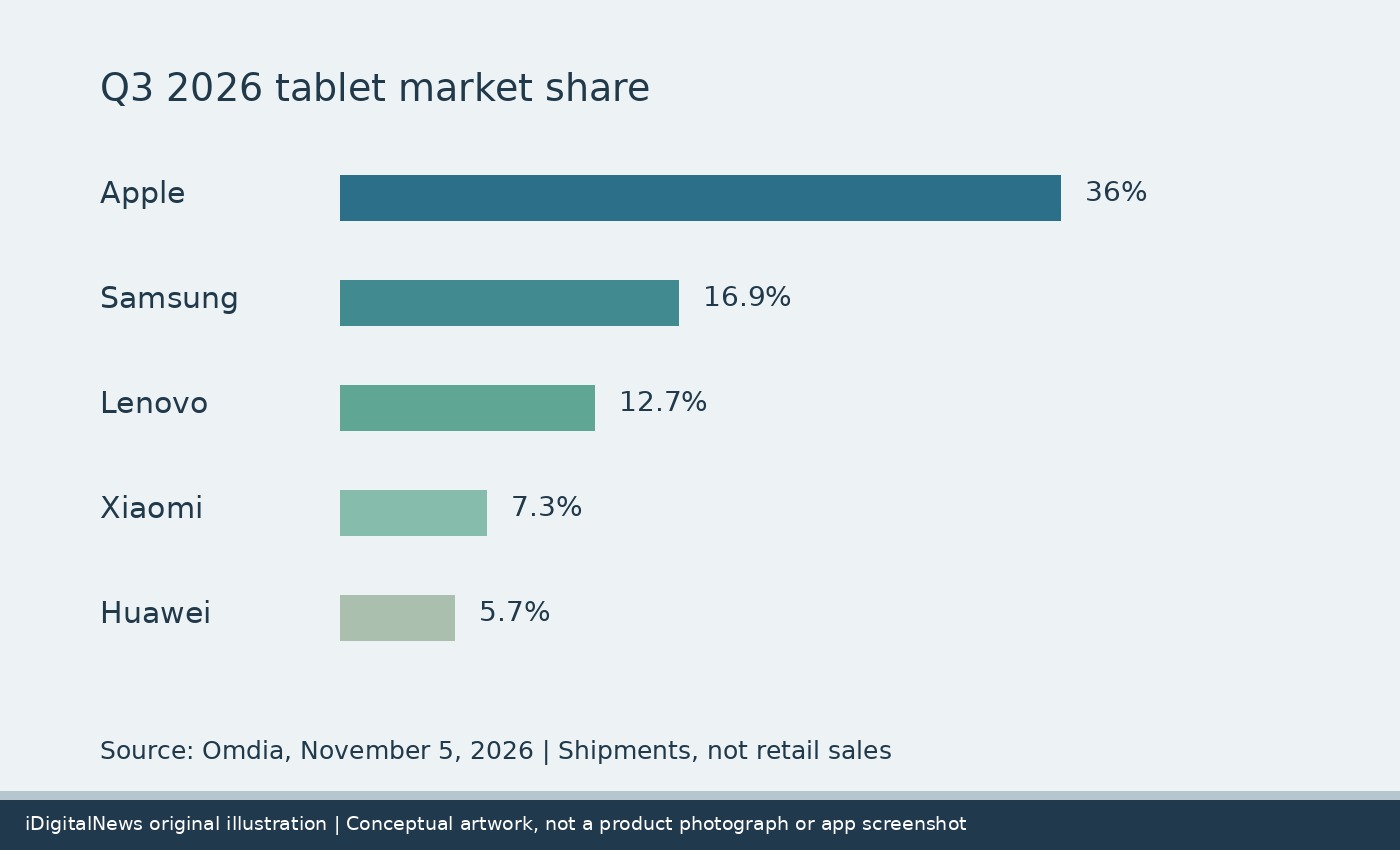
Lenovo shipped 4.1 million tablets, up about 12%, and increased its share to 12.7% from 8.7%. Omdia attributes its overall growth to slate tablets, with stronger sell-in across most regions, even as detachable shipments declined sharply. Xiaomi ranked fourth with 2.3 million units and 7.3% share, despite an approximately 11% volume decline. Huawei shipped 1.8 million tablets, down 43%, for a 5.7% share. These differences show why a single headline percentage cannot describe every vendor's position. They also underline a basic statistical point: share can rise when a company's shipments fall less sharply than the overall market.
Why new launches have not reversed the decline
Omdia researcher Himani Mukka points to persistent supply constraints and fewer meaningful specification upgrades between generations. The report says recent launches have done little to stimulate demand under difficult market conditions. It identifies the Middle East, China and Western Europe as particularly hard-hit regions. Mukka's assessment that a meaningful recovery is unlikely before 2028 is an analyst outlook, not a confirmed timetable. Component availability, product decisions and purchasing behavior can all change. Readers should distinguish the measured third-quarter shipment decline from the forward-looking explanation of what may happen next.
What this means for someone buying a tablet
Shipment statistics measure products entering the channel; they are not a direct count of devices activated by consumers, nor a satisfaction survey. A weak quarter therefore does not establish that a particular tablet is unreliable or unsuitable. Evaluate the actual model against your workload, software support needs, storage requirements and accessory costs. If your current device still handles those tasks, a market report is not a reason to replace it. Conversely, the shipment decline does not prove that a discount or a superior replacement is imminent. The useful takeaway is to judge upgrades by concrete improvements rather than assuming that a newer generation necessarily represents a large step forward.
Sources: Omdia, 9to5Mac. Related: Safari Technology Preview 256.