



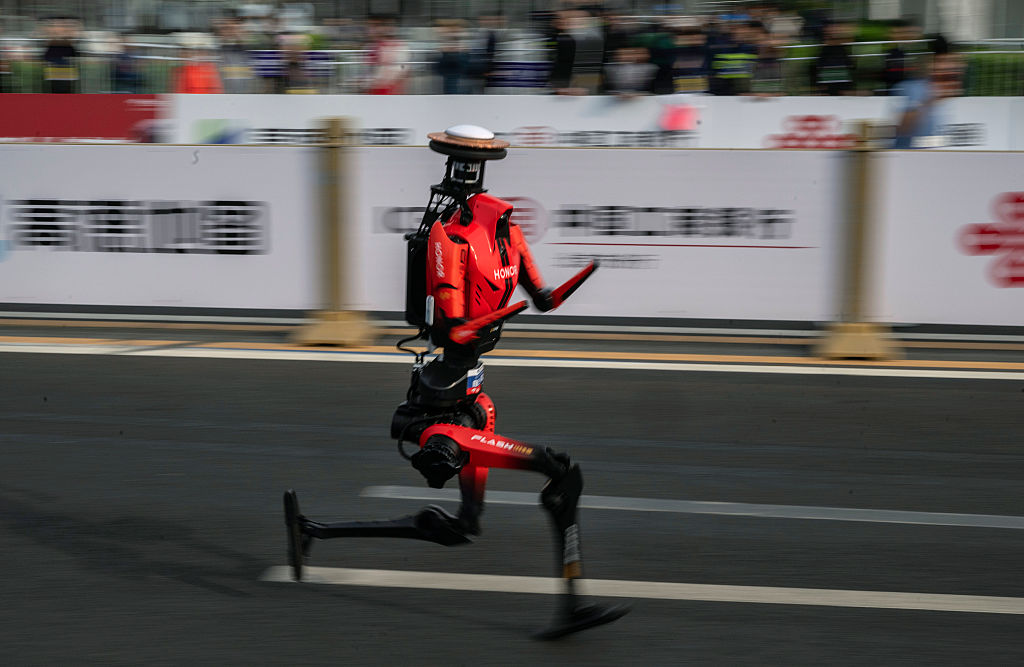
The boundary between human athletic achievement and robotic capability was shattered today in Beijing. In a historic display of rapid technological advancement, a humanoid robot has not only won the 2026 Humanoid Robot Half-Marathon but has done so by clocking a time that leaves the human world record in the dust. This milestone marks a pivotal moment in the evolution of bipedal robotics, signaling that the era of machines matching—and exceeding—human physical performance is no longer a distant future, but a present reality.
The Record-Breaking Run: Honor’s Lightning Strikes
The star of the event was “Lightning,” an autonomous humanoid robot developed by the Chinese smartphone giant Honor. Blazing through the 21.1-kilometer (13.1-mile) course, Lightning crossed the finish line with a net time of 50 minutes and 26 seconds. To put this into perspective, the current human world record for the half-marathon, set by Jacob Kiplimo, stands at 57 minutes and 31 seconds. Lightning didn’t just beat the record; it decimated it by over seven minutes.
While another robot from Honor actually finished faster—clocking 48 minutes and 19 seconds—that unit was remote-controlled. Lightning’s victory is considered more significant because it operated entirely autonomously, navigating the course and managing its pace without human intervention. This feat was achieved through a combination of advanced computer vision, real-time balance algorithms, and a high-torque actuation system designed to mimic the efficiency of human muscle fibers.
From Scoffing to Staggering: A Year of Exponential Growth
The leap in performance over the past twelve months is nothing short of staggering. During the 2025 inaugural race, the winning robot, Tiangong Ultra, finished in 2 hours and 40 minutes—a time that many human hobbyist runners could easily beat. At the time, critics and tech journalists alike scoffed at the “clunky” and “slow” nature of bipedal machines. However, the 2026 results prove that robotics is following an exponential growth curve similar to the Stanford HAI 2026 AI Index findings regarding China’s rapid ascent in the global AI race.
According to Beijing’s E-Town tech hub, approximately 40% of this year’s participants competed autonomously, while 60% were remote-controlled. The diversity of the field was evident, with entries ranging from established tech titans like Honor and Xiaomi to specialized robotics startups. While Lightning stole the show, the event wasn’t without its “human” moments of failure; several robots struggled with the starting line congestion, and one notably collided with a safety barrier early in the race.
The Engineering Behind the Speed
What makes a robot run faster than the world’s elite athletes? According to lead engineers at Honor, the design of Lightning was modeled directly on the biomechanics of outstanding human athletes. The robot features legs measuring approximately 95 cm (37 inches), optimized for a long, efficient stride. Unlike humans, who are limited by biological fatigue and oxygen intake, Lightning’s “cardio” is limited only by its battery discharge rate and thermal management.
The autonomous navigation system used by Lightning is a derivative of the technology found in modern autonomous vehicles, shrunk down to fit within a humanoid frame. It processes thousands of data points per second from LiDAR and depth cameras to maintain a perfect racing line while adjusting its center of gravity to compensate for wind resistance and road incline. This level of precision is something even the most disciplined human runners cannot maintain over 13 miles.
The Future of Human-Robot Competition
The success of the Beijing half-marathon raises profound questions about the future of sports and human-machine interaction. As robots continue to improve, will we see “mixed” marathons where humans and machines compete side-by-side? Or will the physical gap become so wide that such comparisons become meaningless, much like comparing a sprinter to a Formula 1 car?
For now, the achievement serves as a powerful demonstration of how far bipedal robotics has come. The transition from the slow, deliberate steps of early prototypes to the fluid, record-breaking sprint of Honor’s Lightning suggests that we are entering a new era. Whether in search and rescue, logistics, or even professional sports, the humanoid robots of 2026 are proving that they are ready to run with the best of us—and win.
For more on the latest in robotic advancements and AI breakthroughs, check out our coverage of Meta, Google, and OpenAI’s newest innovations.