





Summary
AMD Q3 2026 earnings show how far the company’s center of gravity has shifted toward data centers. Revenue reached a record $13.4 billion, with $8.5 billion coming from the data center segment. Yet the same report showed gaming revenue falling sharply, making this a story about two different markets rather than a uniform boom across computing.
AMD Q3 2026 earnings: the key numbers

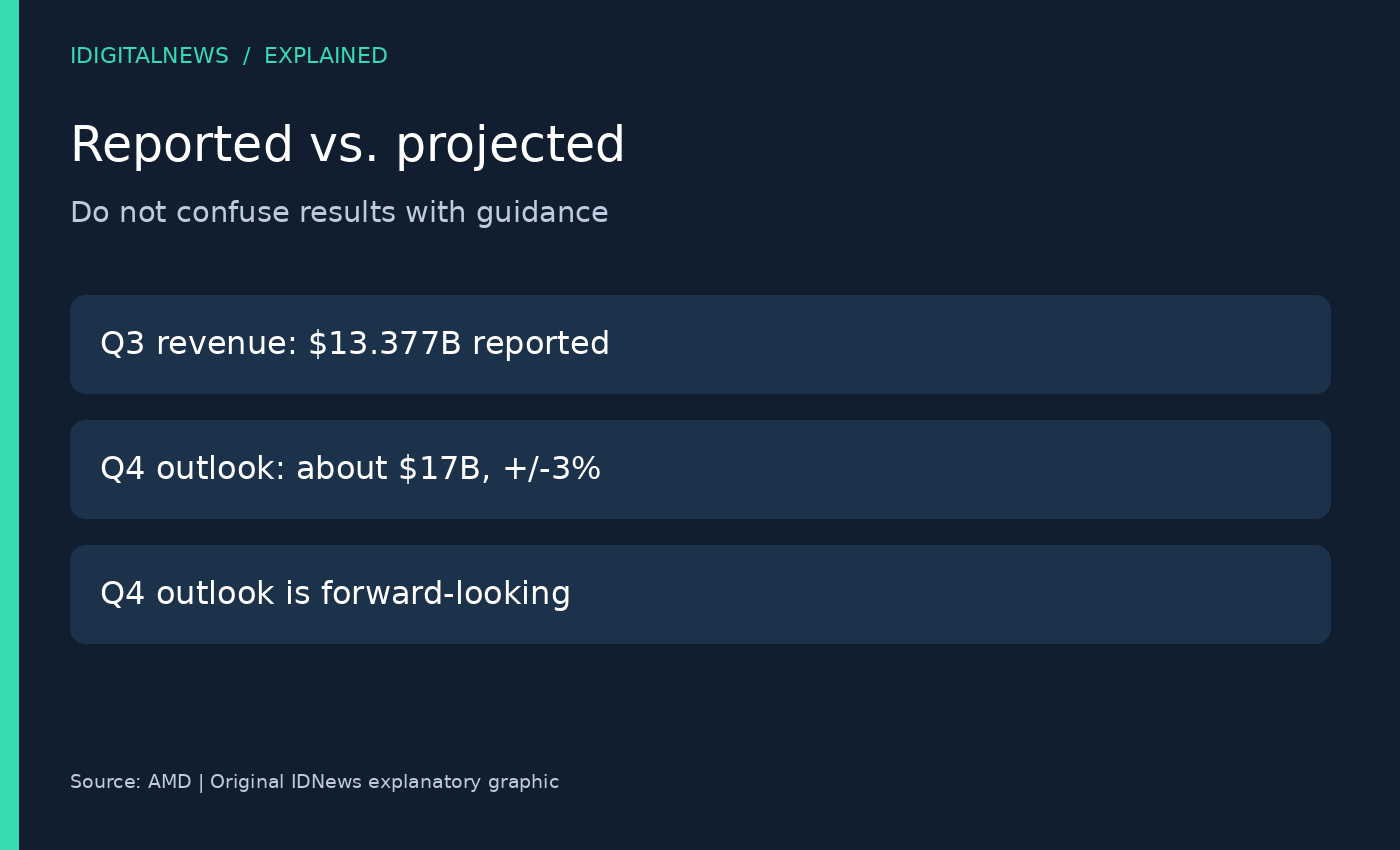
AMD announced the results on November 3 for the quarter ended September 26, 2026. Its financial tables put revenue at $13.377 billion, up 45 percent from a year earlier and 16 percent from the previous quarter. The rounded $13.4 billion figure is the company’s headline number, not a separate measure.
On a generally accepted accounting principles basis, AMD reported net income of $2.428 billion and diluted earnings per share of $1.46. Its non-GAAP results were higher: net income of $3.471 billion and earnings per share of $2.09. These figures should not be mixed when comparing profitability, because the adjusted results exclude items included in the GAAP accounts.
The distinction matters beyond financial terminology. A record sales quarter can coexist with a substantial gap between reported and adjusted earnings. Readers comparing AMD with another chip company should use the same accounting basis and the same period before drawing conclusions about margins or efficiency.
Data centers now account for about 64 percent of revenue
The data center segment generated a record $8.5 billion, up 97 percent year over year. AMD attributed that growth to demand for EPYC processors and the launch of Instinct MI450 Series GPUs. Using the rounded segment number against total reported revenue, data centers supplied approximately 64 percent of company sales.
That mix helps explain why AI infrastructure increasingly shapes AMD’s overall performance. Server CPUs and accelerator GPUs sit inside the same segment, however, so the $8.5 billion figure should not be described as revenue exclusively from AI GPUs. The release does not provide that narrower breakdown.
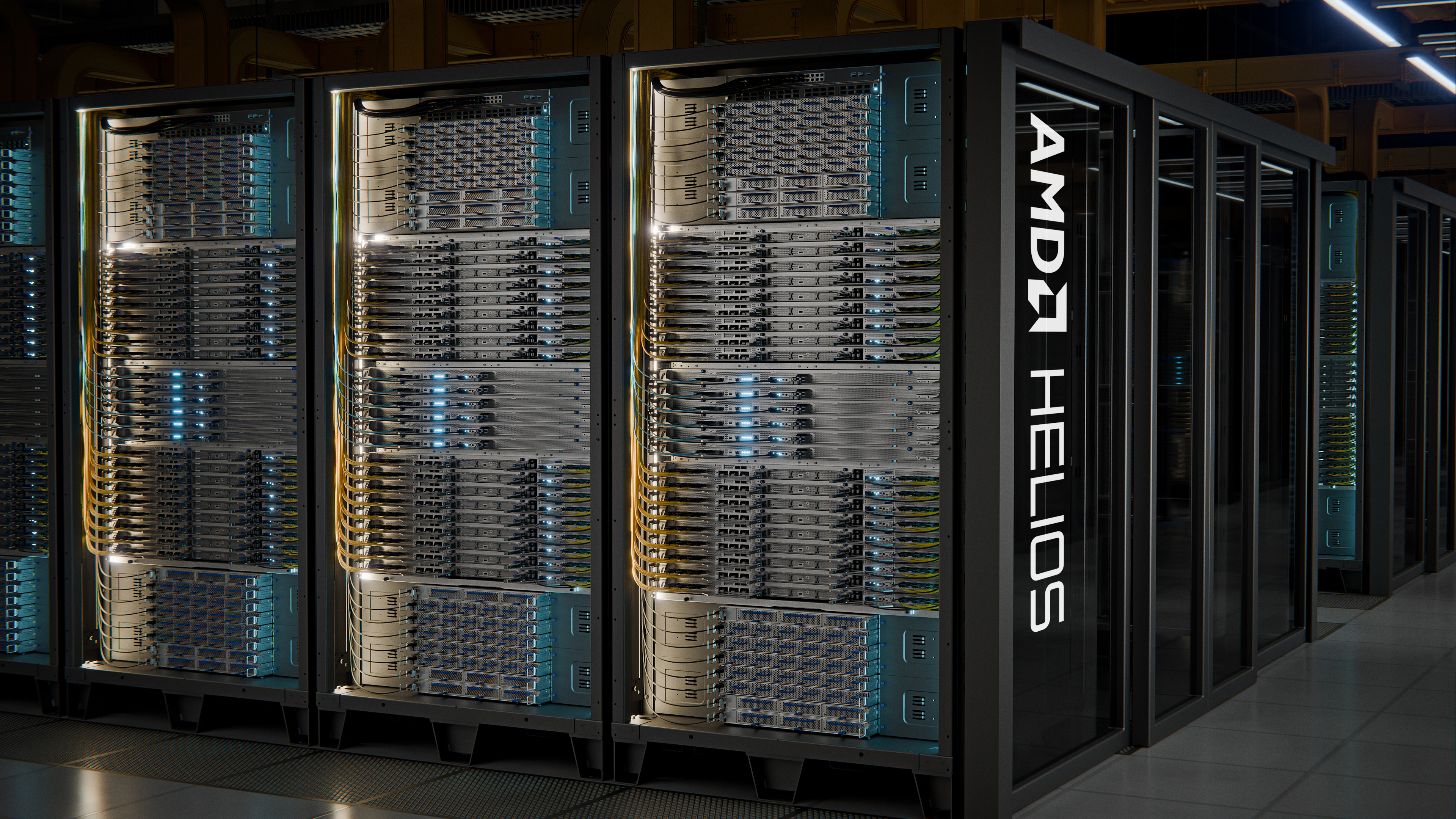
AMD also highlighted customers running workloads on its Helios rack-scale systems and the release of ROCm 10. These announcements show the breadth of the company’s hardware and software effort. They are not, by themselves, independent proof of performance leadership or a guarantee of future market share.
Gaming weakness complicates the consumer picture
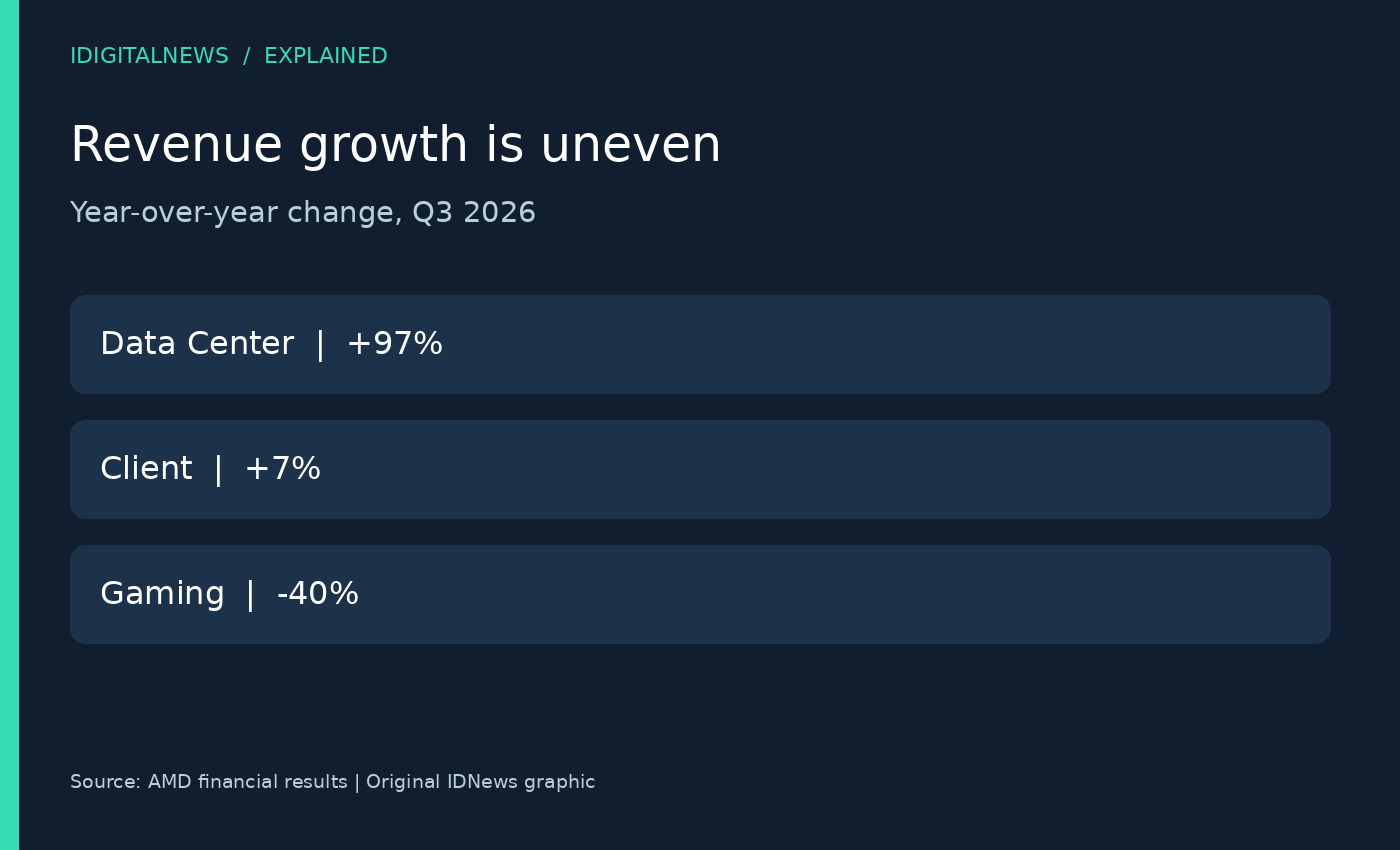
The combined Client and Gaming segment recorded $3.7 billion in revenue, down 8 percent year over year. Inside that total, client revenue rose 7 percent to $2.9 billion, while gaming revenue fell 40 percent to $773 million. AMD said lower semi-custom and graphics revenue drove the gaming decline.
Those separate movements are important for PC buyers. A fall in gaming revenue does not mean every Ryzen product line is declining, and record company revenue does not mean consumer hardware is becoming cheaper. Segment results describe what AMD sold; they do not directly establish retail prices or availability in any particular country.
The Verge’s coverage of the earnings call reported management comments about component-price pressure and slower consumer sell-through. That offers context for the divergence, but it does not identify the price of a future graphics card or prove that a specific gaming product has been canceled.
The $17 billion outlook is a forecast, not a result
For the fourth quarter, AMD expects revenue of approximately $17 billion, plus or minus 3 percent. The company says the midpoint would represent about 66 percent annual growth and 27 percent sequential growth. It also expects a non-GAAP gross margin of approximately 55 percent.
Those are forward-looking estimates. Demand, manufacturing execution, memory availability, export restrictions and other factors can change the outcome. The next useful test is whether AMD can convert its infrastructure pipeline into delivered revenue while preserving margins, rather than simply announcing more systems or partnerships.
For readers following the AI market, the takeaway is concrete: data centers already dominate AMD’s sales mix, while gaming faces a different cycle. For consumers, there is no automatic reason to treat an earnings record as a buying signal. Actual system prices, independent benchmarks and availability remain the more useful checks.
One detail to watch in the next report is the relationship between client growth and gaming weakness. Combining the businesses into one segment can obscure that difference at a glance. Looking at the disclosed subcategories alongside the data center total gives a clearer account of which customers are driving growth. It also avoids turning an infrastructure investment cycle into an unsupported claim about demand for every kind of personal computer.
Sources: AMD financial results | The Verge
Related coverage: Tech Companies on iDigitalNews.
Featured image: AMD Helios data center hardware. Official product image; credit: AMD. Official source.