





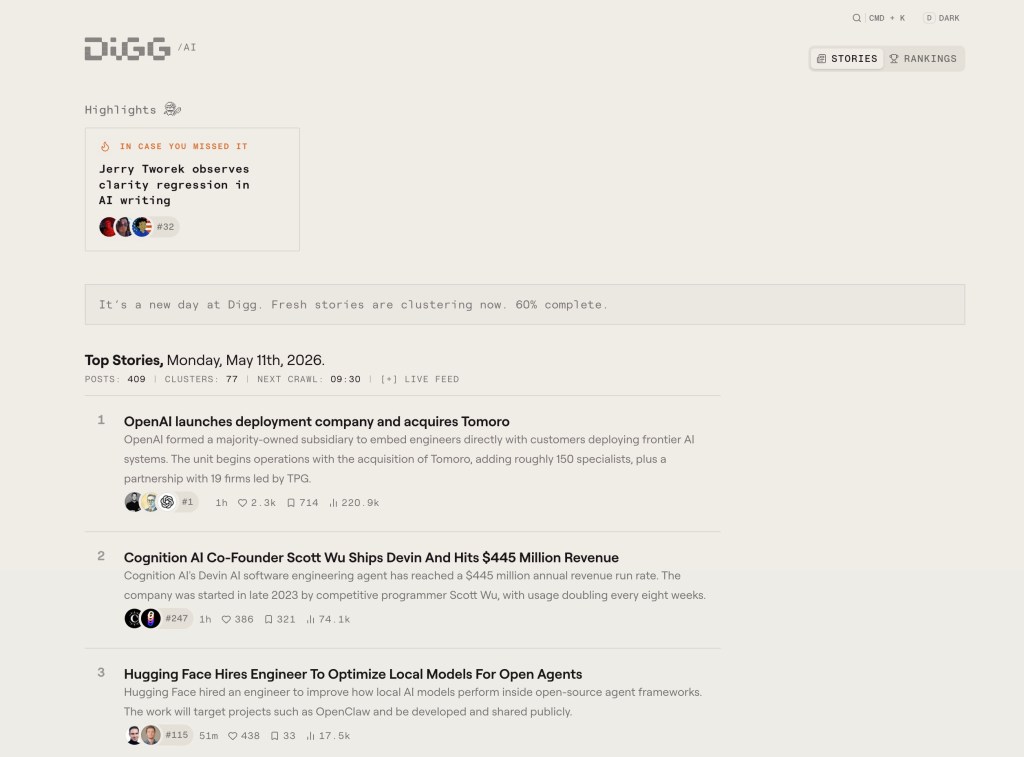
Digg, a name synonymous with the early days of social news aggregation, is making another attempt at relevance, this time by pivoting into the burgeoning field of AI-powered news curation. After a brief and unsuccessful stint as a Reddit competitor, the platform, under the renewed leadership of founder Kevin Rose, has relaunched with a singular focus: to track and surface the most influential voices and trending stories within the AI landscape.


Digg’s Rocky Road to AI Aggregation
The journey for Digg has been anything but smooth. After its initial success as a Web 2.0 darling, the platform struggled to adapt to the evolving digital media landscape. A previous relaunch, intended to challenge Reddit, faltered due to an inability to manage bot traffic and a lack of clear differentiation. This led to layoffs and a temporary shutdown in March 2026, prompting Kevin Rose, a partner at True Ventures, to return full-time to steer the ship once more.


The New Vision: AI-Powered News Curation
The latest iteration of Digg, previewed by Rose in May 2026, marks a significant departure from its past. The platform no longer resembles a Reddit clone but instead focuses on ranking news, specifically within the AI domain. The core idea is to identify and amplify the stories that resonate most with influential figures in the AI community. Digg aims to cut through the noise by tracking engagement and sentiment across platforms like X (formerly Twitter), where much of the real-time discussion around AI unfolds.

How Digg Leverages X for Real-Time Insights
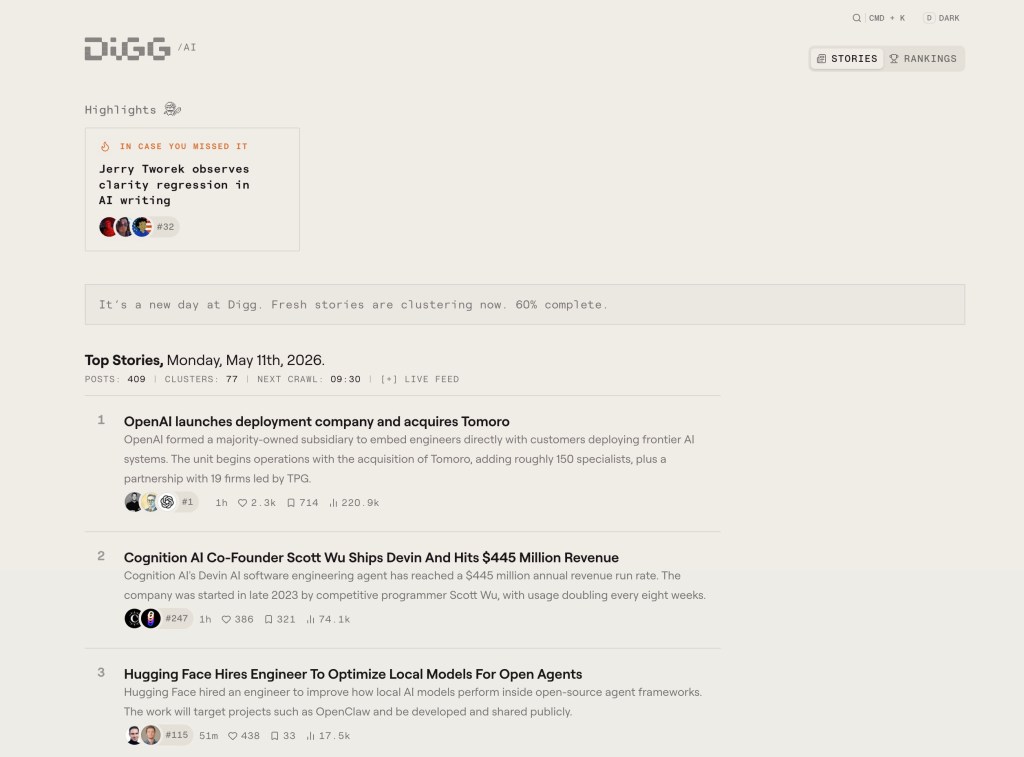
One of the most innovative aspects of the new Digg is its reliance on real-time data from X. The platform ingests content from X to determine what’s being discussed, employing sentiment analysis, clustering, and signal detection to identify the most important stories. As Kevin Rose noted, when prominent figures like OpenAI CEO Sam Altman engage with an AI-related story on X, it often triggers a chain reaction of discussion and propagation. Digg’s system is designed to track and highlight this increased engagement, offering a unique perspective on the virality and impact of AI news.
Potential Impact and Challenges
For individuals deeply immersed in the AI space, Digg could become a valuable resource for staying abreast of breaking news and influential discussions without having to sift through countless feeds. It offers a data-driven approach to news aggregation, exposing the impact of X-based engagement through charts and graphs. However, the platform faces several challenges. Its current focus on AI news, while timely, may limit its broader appeal. Furthermore, the absence of on-site discussion might deter users accustomed to interactive news platforms.
A Lifeline for Publishers?
Despite these challenges, Digg’s relaunch could offer a glimmer of hope for publishers struggling with declining clicks due to changes in Google’s algorithms and the rise of AI Overviews. If Digg gains traction, it could serve as a significant source of website traffic, directing users to original news sources rather than simply providing AI-generated summaries. This potential to drive traffic back to publishers could be a crucial factor in its long-term success.
The Future of News Aggregation in the AI Era
Digg’s latest pivot highlights a broader trend in the news industry: the increasing role of artificial intelligence in content curation and discovery. As AI models become more sophisticated, their ability to identify, analyze, and present information will continue to evolve. Digg’s attempt to leverage AI for human-centric news aggregation—by focusing on influential voices—represents an interesting experiment in this evolving landscape. Its success or failure will offer valuable insights into how legacy platforms can adapt and thrive in an era dominated by AI.
For more insights into the impact of AI on various industries, consider reading our article on AI Breakthroughs: Meta, Google, and OpenAI Unveil Future-Shaping Innovations.